
1325–1521: The Mexica Empire
The old codices tell that, in remote times, the Mexica were a wandering people. They came from a distant place, wrapped in myth and memory, called Aztlán. Under the harsh sun and guided by the voice of their god Huitzilopochtli, they moved on without rest, carrying their gods in their hearts and their hopes in their feet.
For years they wandered through valleys and mountains, facing hunger, battles and the contempt of more powerful peoples. They were seen as barbarians, as landless foreigners, forced to serve as mercenaries in other people's wars. But the prophecy sustained them: one day they would find the sacred sign, the place that would be theirs forever.
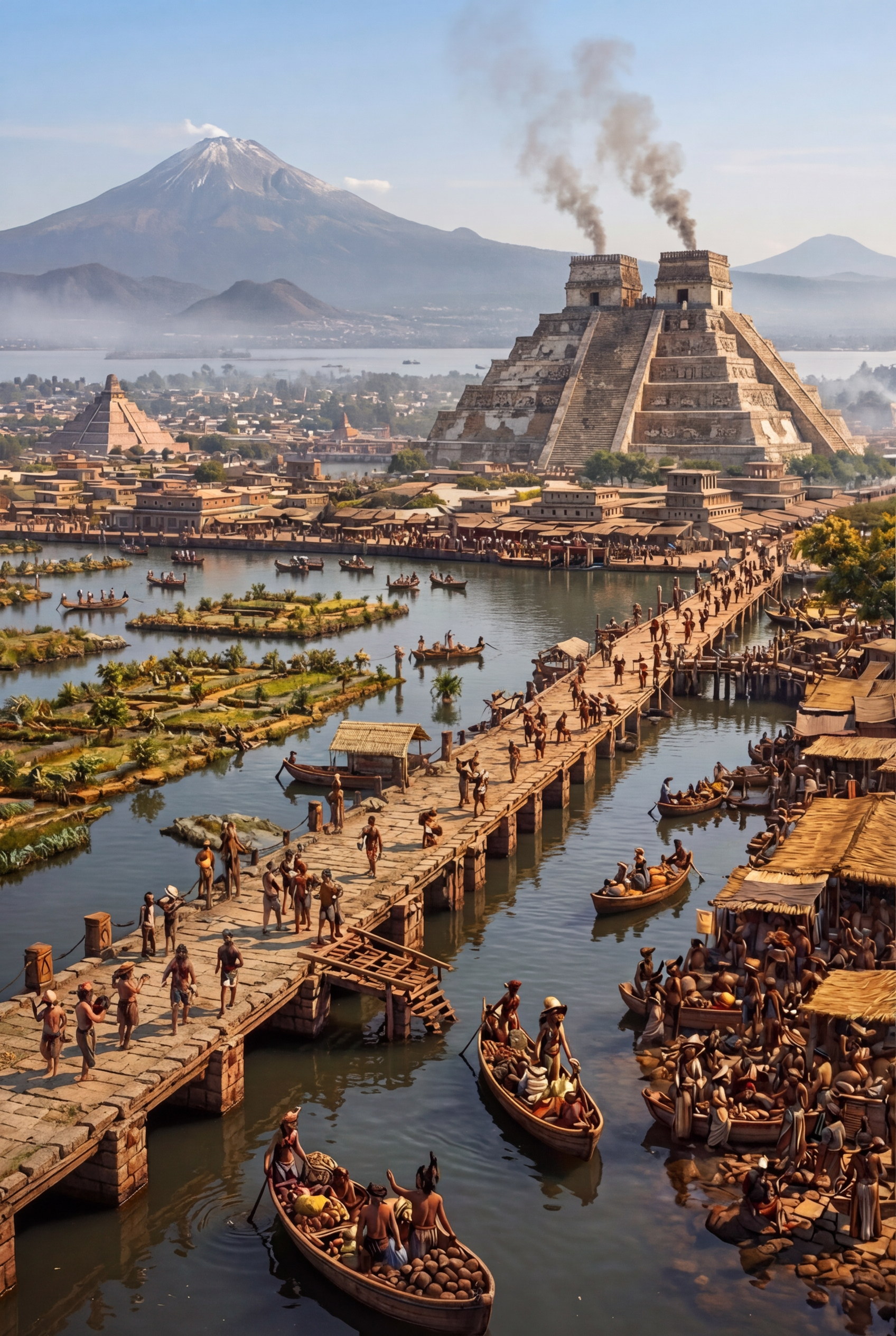
It was in the year 1325 that, in the middle of Lake Texcoco, they saw it: an eagle perched on a prickly pear cactus, devouring a serpent. There, among islets and brackish waters, the Mexica raised the first huts of Mexico-Tenochtitlan. The ground was unstable, the surroundings hostile… but it was also a sanctuary.
At first they were vassals of the powerful Tepanecs of Azcapotzalco. They paid tribute and endured humiliation. But the eagle's patience has talons. When the moment came, they allied with the peoples of Texcoco and Tlacopan, and together they overthrew their former oppressors.
From that victory the Triple Alliance was born (1428). With it, the city that had begun as a settlement on the water became the capital of an empire. Under the command of their Huey Tlatoani—Itzcóatl, Moctezuma, Axayácatl, Ahuízotl—the Mexica armies extended their rule from the shores of the Gulf to the mountains of the Pacific.
In a few years, what had been a wandering and despised people became the most powerful nation in Mesoamerica. The eagle on the cactus was no longer just a divine sign: it was the standard of an empire.
The organisation of the empire
In the heart of Tenochtitlan, where the sun rose over the lake and the temples soared like mountains of stone, life followed an order as precise as the sacred calendar.
At the summit of power reigned the Huey Tlatoani, lord of men and spokesman of the gods. Beside him, the Cihuacóatl advised on the affairs of the city, and a council of nobles set the course of the empire. Beneath them, a human pyramid sustained Mexica greatness: the pipiltin, nobles by lineage; the macehualtin, chinampa farmers, craftsmen and warriors; the pochtecas, intrepid merchants who brought news and riches from distant lands; and, at the base, the tlacotin, slaves who, even in their condition, could dream of regaining their freedom.
In every district the young prepared themselves: the sons of nobles in the calmécac, learning the word of the gods and the strategy of war; those of the common people in the telpochcalli, where sweat, discipline and weapons were the lesson. All knew that life was preparation for battle and service to the city.
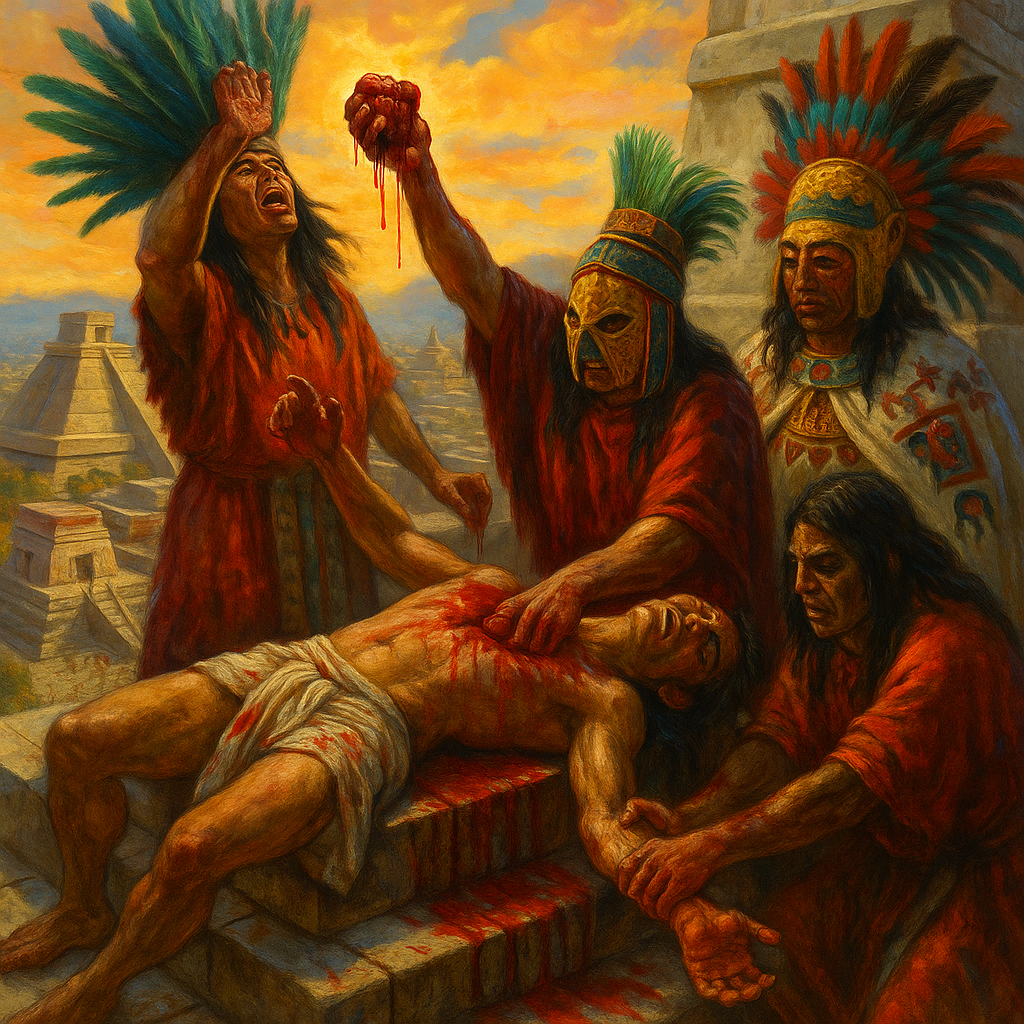
Religion embraced everything. The days were ruled by the cycles of two calendars that turned like divine gears. In the temples they invoked Huitzilopochtli, the warrior sun; Tlaloc, giver of rain; Quetzalcóatl, wise creator of maize; and Tezcatlipoca, lord of destiny. For them blood flowed on the altars, because in their worldview the sun needed nourishment to keep moving across the sky.
Tenochtitlan was a world of water and stone, a city that breathed among canals and causeways. Its markets bustled with voices and colours, and between 200,000 and 300,000 souls lived in its streets. The empire, spread across mountains, coasts and valleys, came to bring together more than 5 million people under the shadow of the eagle and the cactus.
Thus, through discipline, faith and sheer numbers, the Mexica built one of the most powerful civilisations of their time, an empire where life and death were intertwined like two faces of the same sun.
The Mexica army
The sun rose over Lake Texcoco and the city of Tenochtitlan awoke with it. Among the canals and chinampas, the macehualtin prepared maize and tended the crops that fed thousands. In the Tlatelolco market, the voices of traders would soon ring out offering cacao, jade and quetzal feathers.
But not the whole city was thinking of barter or the fields. In the telpochcalli, young men trained from dawn with wooden shields, spear-throwers and obsidian swords. Every blow, every fall, every wound was a lesson: all men were destined to be warriors, for war was the heart that kept the empire beating.
At the top, the Huey Tlatoani and his council decided the course of the Triple Alliance. Below, the social pyramid was held up by nobles, farmers, merchants and slaves, each with their role in the great machine. And above all rose religion: the gods demanded blood, and it was the army that had to bring it.
That is why, when the conch shells sounded to announce a campaign, the whole city was transformed. The Mexica army was colossal: it could field 100,000 to 200,000 men on campaign, summoning not only the Tenochca but also their allies from Texcoco and Tlacopan, and contingents from subject peoples who marched under the banners of the eagle and the jaguar.
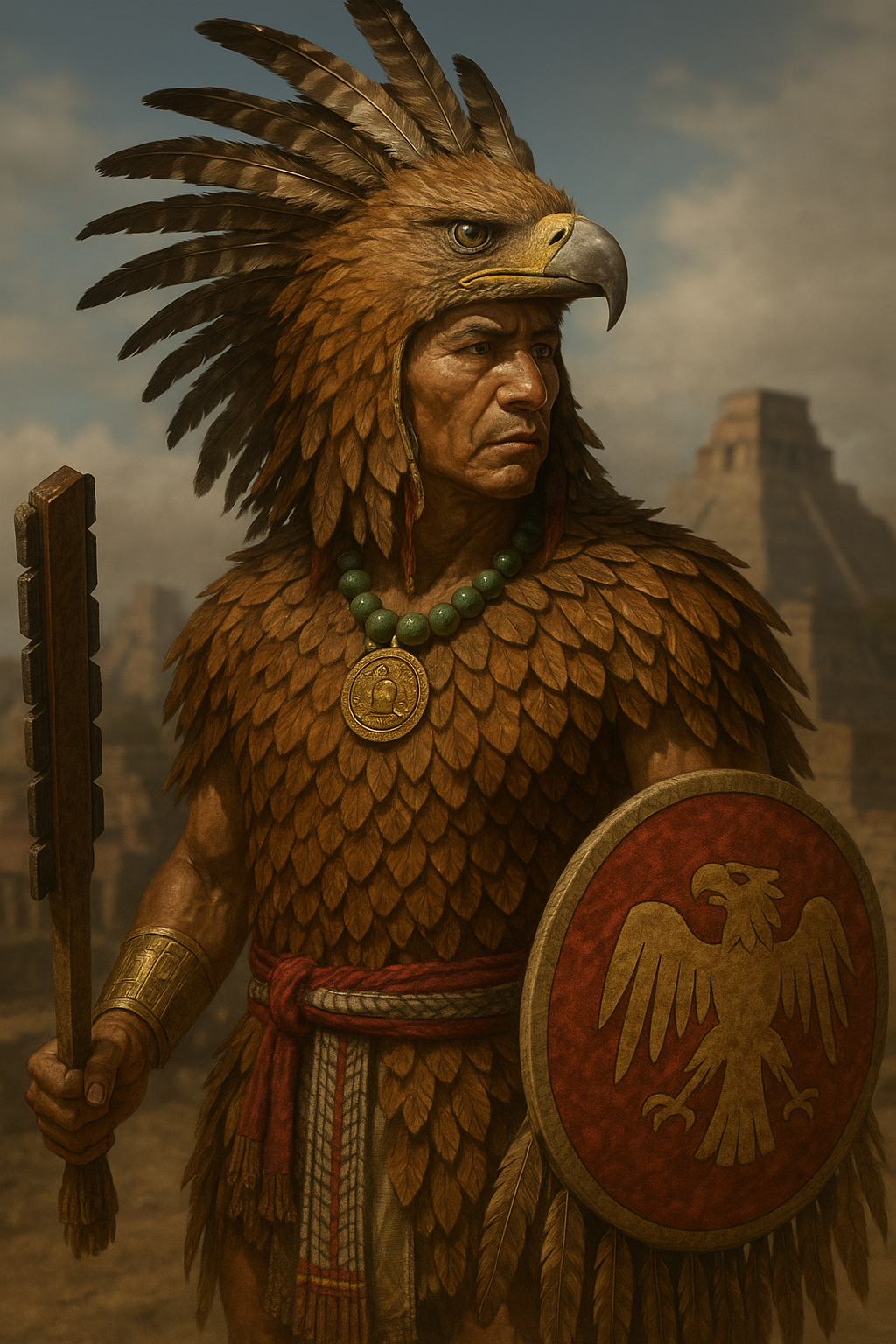
At the front marched the elite warriors: the eagle knights, wrapped in feathers that gleamed in the dawn light, and the jaguar knights, clad in spotted skins that evoked the nocturnal strength of the great cat. Behind them, endless columns of soldiers carried their macuahuitls, slings and spear-throwers, while priests chanted and the pochtecas went ahead as spies and diplomats.
The spectacle was overwhelming: the causeways filled with endless ranks, drums thundered in the air and banners waved like seas of colour. It was a human tide, able to engulf entire cities, advancing not only to conquer but to maintain the order of the cosmos. For in the Mexica view, without prisoners there were no sacrifices, without sacrifices the sun would not rise, and without the sun the world would sink into darkness.
As evening fell, the temples of the great city were tinged red by the setting sun. At the Templo Mayor the priests received the day's prisoners, and blood flowed as an offering to Huitzilopochtli. For the ordinary citizen, this confirmed that war was not only a duty: it was the guarantee that a new day would be born.
Thus Tenochtitlan breathed with two lungs: the work of its people and the strength of its army. Between them they kept alive an empire that, at its height, brought together more than 5 million people, with its capital one of the largest and most powerful cities in the world.
The empire's alliances and enemies
In the heart of the Valley of Mexico, Tenochtitlan shone like a sun that both attracted and burned. Under the gaze of the Huey Tlatoani, the surrounding peoples were divided between reluctant allies and implacable enemies.
After the great victory over Azcapotzalco, the Triple Alliance was born (1428):
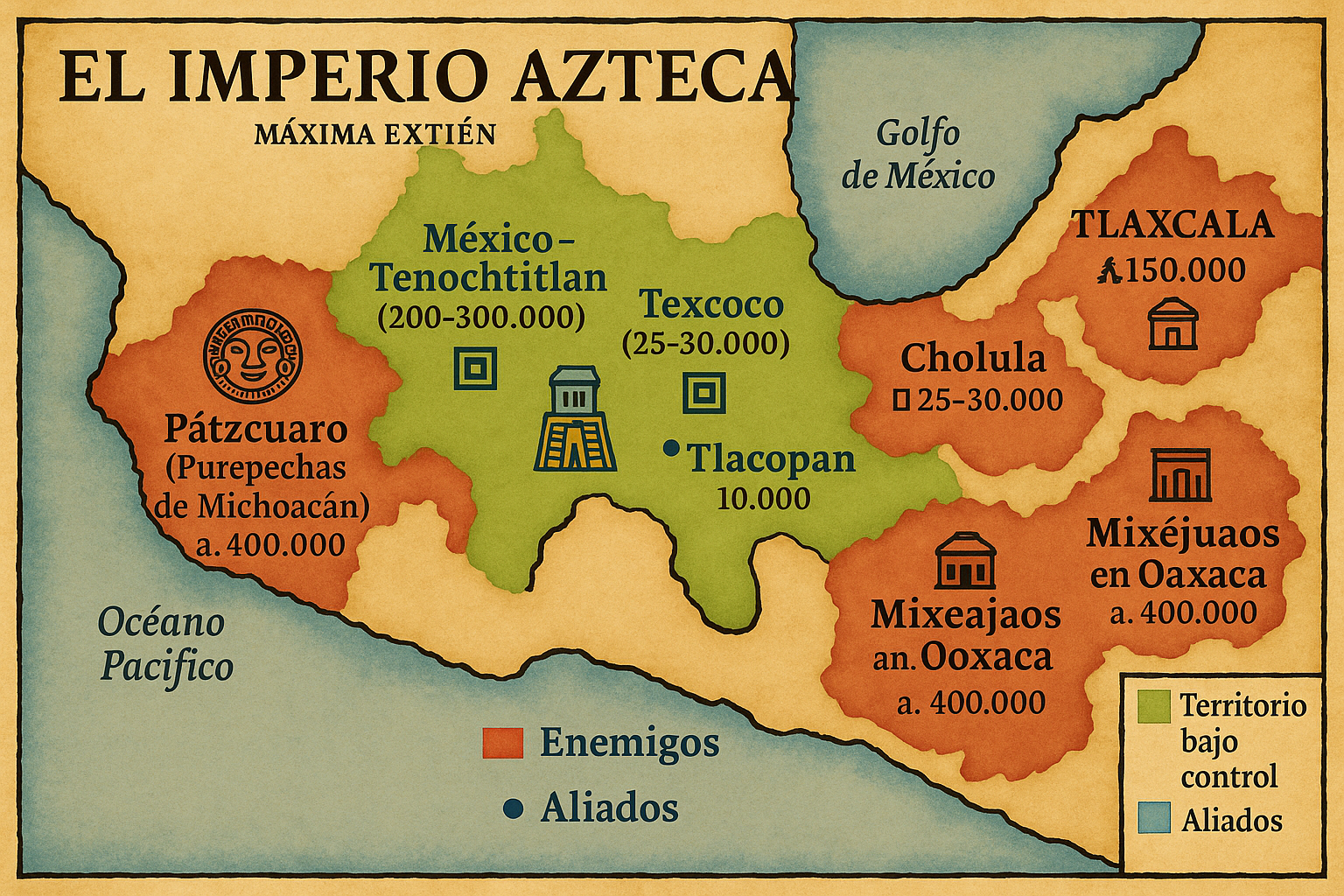
- Tenochtitlan, with some 200,000 to 300,000 inhabitants, was the most feared military power.
- Texcoco, with around 25,000 to 30,000 souls, contributed culture, learning and political tradition.
- Tlacopan, smaller, with some 10,000 inhabitants, completed the coalition as the junior partner.
Together, these cities built an empire that came to rule more than 5 million people.
But all around, like storm clouds, rose its enemies. The most feared were the Tlaxcalans, who lived in a fertile republic of around 150,000 inhabitants. Surrounded by Mexica lands, they resisted fiercely. With them were fought the famous flower wars, arranged battles in which blood and captives were worth more than conquest itself.
Further south, in the Puebla valley, lay Huejotzingo (some 20,000 inhabitants) and Cholula (a sacred city of around 25,000 to 30,000 inhabitants). Sometimes they fought, sometimes they negotiated, but they were never fully subjected to the Mexica yoke.
Further still, to the west, lived the only kingdom able to look the Tenochca eagle in the eye: the Purépecha of Michoacán. With more than 400,000 inhabitants across their domain, their well-armed and organised armies defeated the Mexica several times, marking the western limit of the empire.
In the southern mountains, the Mixtecs and Zapotecs of Oaxaca, with populations in the tens of thousands in cities such as Zaachila and Mitla, resisted or made pacts as circumstances required, preserving their culture and lordships in the face of Mexica campaigns.
And so the empire lived between alliances and wars, between forced tribute and constant resistance. The greatness of Tenochtitlan rested on a network of conquered peoples, but also on the resentment of those awaiting their chance. That is why, when the bearded strangers arrived in 1519, many peoples saw them as more than invaders: they saw them as the key to freeing themselves from the Mexica eagle.