1502–1533: Atahualpa

Atahualpa, the Last Son of the Sun
The boy from the north
Atahualpa was born around 1502 in the northern lands of the Inca Empire, probably in or near Quito, when Tahuantinsuyo was still at the height of its power. He was not born in Cuzco, the navel of the world, but on the northern frontier, where the empire merged with jungles, mountains and recently conquered peoples. That origin would shape his destiny.
He was the son of the Sapa Inca Huayna Cápac, the greatest ruler the Incas ever knew, and of a princess from Quito. From an early age Atahualpa understood that his blood was imperial, but his birthplace was not. He was not the natural heir, and in the rigid order of Cuzco that weighed on him like a silent shadow.
Huayna Cápac, a tireless warrior, took him on military campaigns. There, among armies, ritual sacrifices and conquered cities, Atahualpa was formed. He was trained not as a priest or administrator but as a general. He learned to read men's gestures, to gauge the enemy's fear, to use cunning when force was not enough.
Even then his character stood out: reserved, observant, distrustful, but also decisive. He was not charismatic like other Inca princes; he commanded respect without raising his voice.
A poisoned inheritance
Tragedy came from the invisible. Around 1525–1527 an epidemic—probably smallpox, brought from Central America by the Europeans—devastated the empire. Thousands died. Huayna Cápac died too, and shortly afterwards his designated heir, Ninan Cuyuchi.
Tahuantinsuyo was left without a clear successor. In Cuzco the nobles proclaimed Huáscar, Atahualpa's brother, as the new Sapa Inca. Huáscar was the legitimate heir according to Cuzco tradition, but he lacked the military support of the north. Atahualpa, in Quito, was recognised by his father's veteran armies.
So began the Inca civil war (1527–1532), the bloodiest conflict in the pre-Hispanic history of the Andes. Atahualpa did not proclaim himself emperor at once. He waited. He let Huáscar wear himself out. When the time came, he sent his most feared generals: Chalcuchímac, Quizquiz and Rumiñahui. They devastated the south. Cities were burned, temples desecrated, nobles executed.
Huáscar was captured in 1532, defeated near the Apurímac River. Atahualpa had won. The empire was his. But victory came too late.
The men of iron
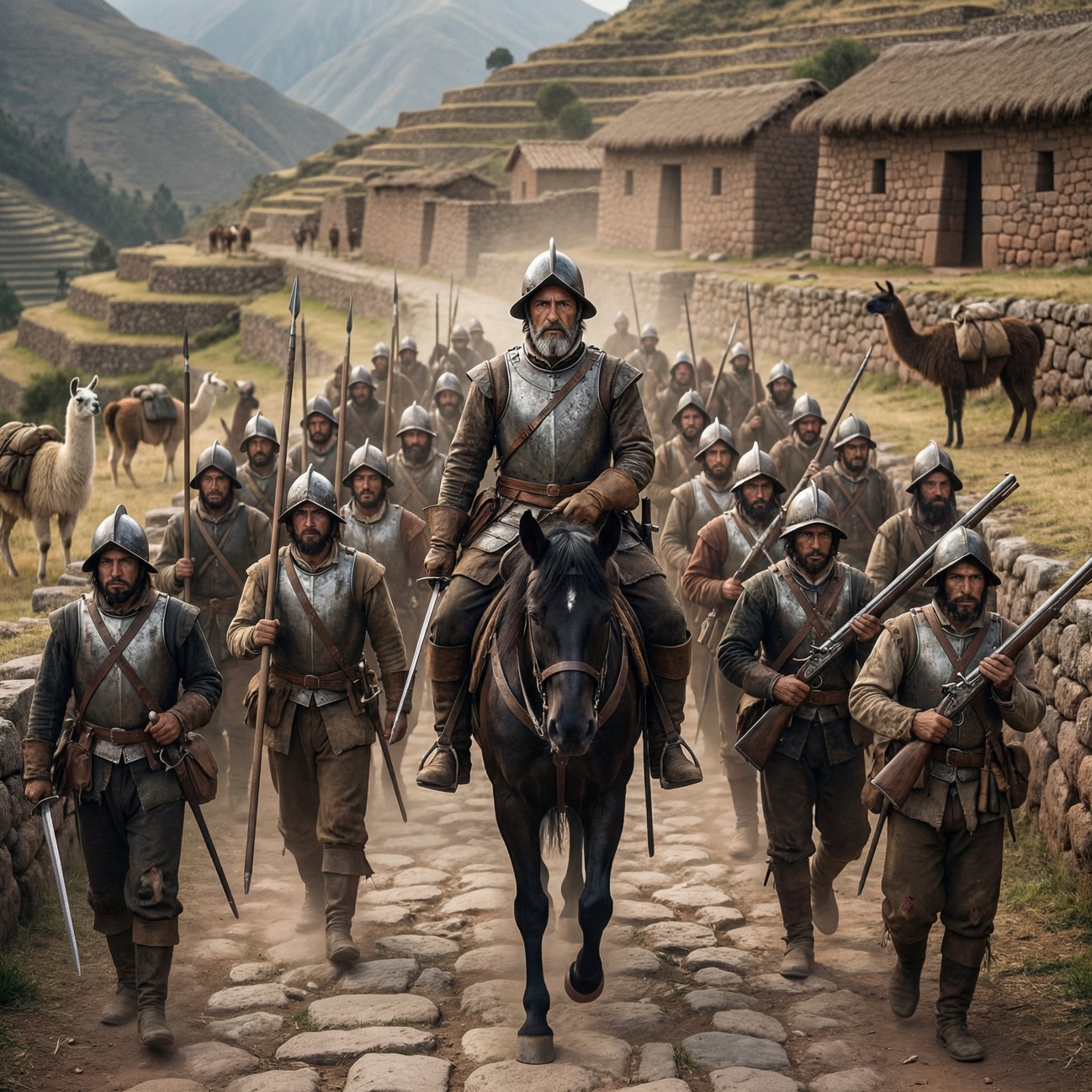
While Atahualpa rested at Cajamarca, enjoying hot springs and ritual celebrations, strange news arrived: bearded men clad in metal, riding unknown animals, were advancing from the coast. They were just 168 Spaniards, led by Francisco Pizarro.
Atahualpa felt no fear. How could he fear a handful of foreigners when he had defeated armies of tens of thousands? He believed they were traders or minor envoys. He decided to receive them.
On 16 November 1532, in the square at Cajamarca, the ancient world and the modern world collided for the first time in the Andes. Atahualpa entered the square carried on a litter, surrounded by nobles, unarmed, confident in his divine power. Before him, a friar—Vicente de Valverde—spoke of one God and a distant king. He handed him a book. Atahualpa looked at it and held it to his ear. He said nothing. He let it fall.
It was the signal. The cannon thundered. The horses charged. Steel tore flesh. Within minutes, thousands of Incas lay dead. Atahualpa was taken alive. Never before had a Sapa Inca been captured.
The ransom of an empire
A prisoner at Cajamarca, Atahualpa showed his intelligence even in defeat. He watched his captors, learned their rivalries and understood their greed. Then he offered the unthinkable: to fill one room with gold and two with silver up to the height of his outstretched arm, in exchange for his freedom.
For months, treasures arrived from all over the empire: idols, sacred vessels, temple plates, statues of the Sun. The gold of Tahuantinsuyo was melted down, reduced to ingots, destroyed as culture to become plunder.
Meanwhile, Atahualpa continued to govern from his cell. He gave orders. He had Huáscar executed to prevent the Spaniards from using him as a rival. That act sealed his fate. When the ransom was completed in 1533, the Spaniards no longer needed the Inca.
Trial and death
Atahualpa was subjected to an absurd trial: he was accused of idolatry, fratricide, treason and conspiracy. He did not understand the charges. He did not grasp the logic. For him, the trial was an incomprehensible farce.
The sentence was death at the stake. Terrified that his body would not be able to join the gods—for fire prevented eternal life—he accepted Christian baptism. He was baptised Francisco Atahualpa.
On the night of 26 July 1533, Atahualpa was garrotted at Cajamarca. He was little more than thirty years old. With him died the last effective emperor of the Inca Empire.
Epilogue: the shadow of the Sun
After his death, Tahuantinsuyo was never the same again. The Spaniards installed puppet Incas, but the sacred order had been broken. Civil war, betrayal and conquest had become entangled in a knot that could not be undone.
Atahualpa was neither a romantic hero nor a cruel villain. He was a man of his time, forged by war, ambition and absolute power. Intelligent, cold, strategic. The victim of a clash of worlds that no one could fully understand.
Today his figure lives on in Andean memory. He has fewer statues than other leaders, but his name resonates as the symbol of the end of an era. In Quito, Cajamarca and Cuzco, his memory is still a matter of dispute, an open wound, an unfinished story.
The Son of the Sun fell not only to the foreign sword but through the internal cracks of his own empire. And so ended the ancient world of the Andes.