
The Conquest of the Inca Empire (1532–1533): When the Sun Fell
A weary empire (1529–1532)
The Empire was immense, but it was exhausted. From Quito to the Collasuyo, Tahuantinsuyo still beat with the regularity of a carefully ordered world. The quipus recorded harvests, tribute and levies; the chasquis ran along the stone roads carrying imperial orders; the tambos and colcas overflowed with maize, quinoa and charqui. The State seemed indestructible. Its armies could mobilise tens of thousands of men. The Sun was still worshipped as the source of all authority.
But the sacred order had been broken.
The death of the Inca Huayna Cápac around 1525, far from Cuzco, and that of his legitimate heir had left the Empire without a clear centre. The disease—smallpox arriving from the north, even before the Spaniards appeared—was read as an evil omen. The world had come out of joint.
The civil war between Huáscar and Atahualpa tore the heart out of the Empire. For three years, from 1529 to 1532, Inca armies fought Inca armies. Veteran generals such as Quisquis and Chalcuchímac marched on Cuzco. Whole cities changed sides. Noble lineages were wiped out. For the first time, war was neither ritual nor unifying: it was total.
When Atahualpa won and Huáscar was taken prisoner in 1532, the Empire was no longer invulnerable. It had won power, but lost something deeper: spontaneous loyalty. It ruled over an immense territory, yes, but one full of silent resentments.
Atahualpa, a son of the north, set up his court in Cajamarca, far from Cuzco, the sacred capital. His power was real, backed by victorious armies, but recent; his legitimacy was disputed by the old Cuzco lineages. The Inca had won the war, but not the peace.
And it was then that news came from the sea.
The men from the sea (1526–1532)
They were not kings.
They were not nobles.
They were not many.
Francisco Pizarro had survived jungles, famine and failure. He had spent years exploring inhospitable coasts, losing men, watching others give up. In his fifties, he was a hardened, patient man, aware that this enterprise was his last chance.
With him marched Hernando de Soto, a bold and reckless horseman; Hernando Pizarro, his brother, methodical and cold; Gonzalo Pizarro; and captains such as Sebastián de Benalcázar. All were veterans of wars in the Caribbean or Central America.
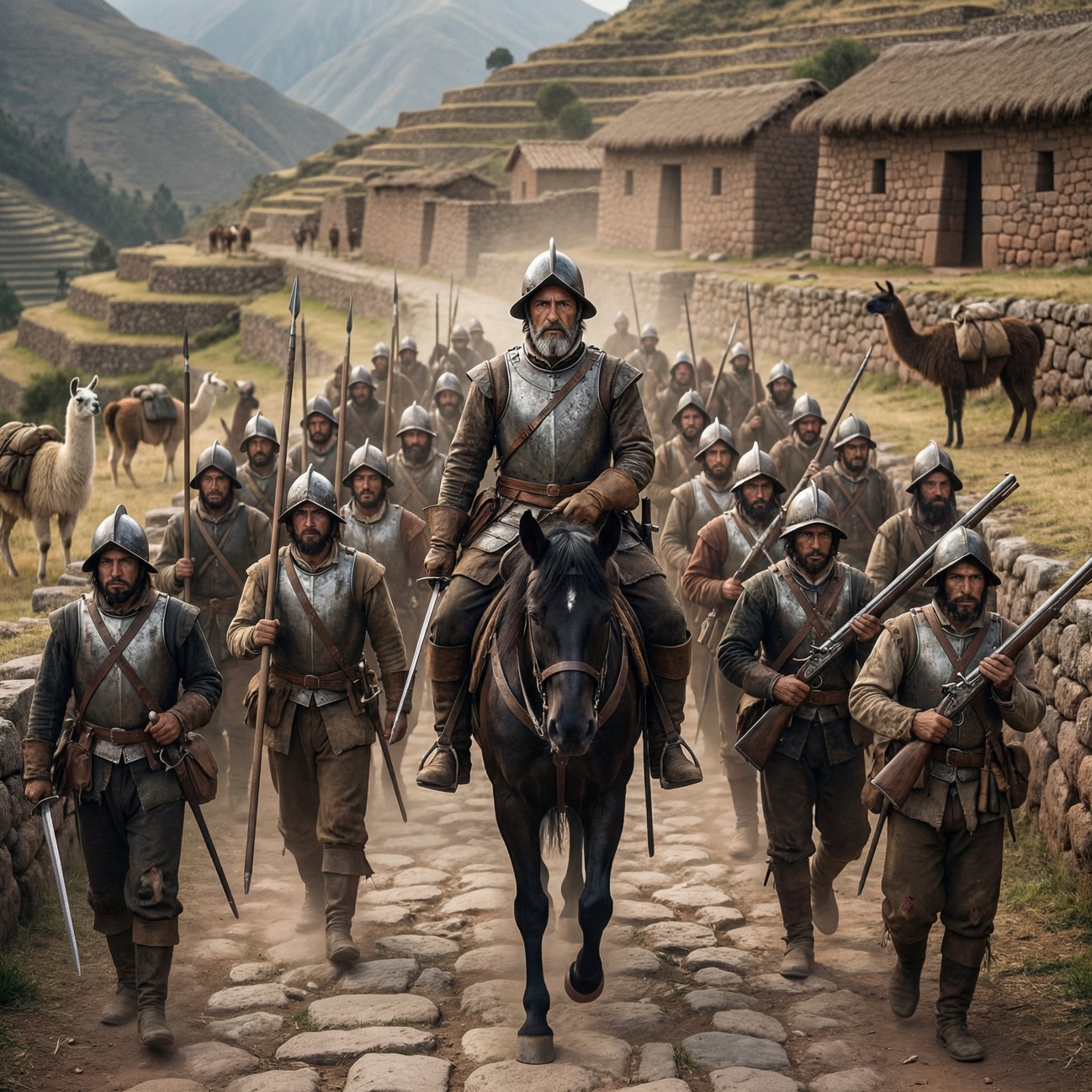
In September 1532, the Spanish force—168 men, 62 of them on horseback—left the coast and headed into the highlands. They carried steel swords, arquebuses, small pieces of artillery, horses never before seen in the Andes… and the experience of having seen other worlds fall.
As they advanced, they were astonished. Paved roads, suspension bridges over chasms, state storehouses perfectly stocked. The Empire itself made their advance easier. Without knowing it, the Inca State was sustaining its future conquerors.
The news they received was contradictory: a victorious emperor, countless armies, unimaginable riches. But they also heard of divisions, of peoples punished for rebelling, of resentful curacas.
Pizarro grasped something essential: it was not enough to defeat the army; he had to strike the symbol.
Cajamarca (16 November 1532)
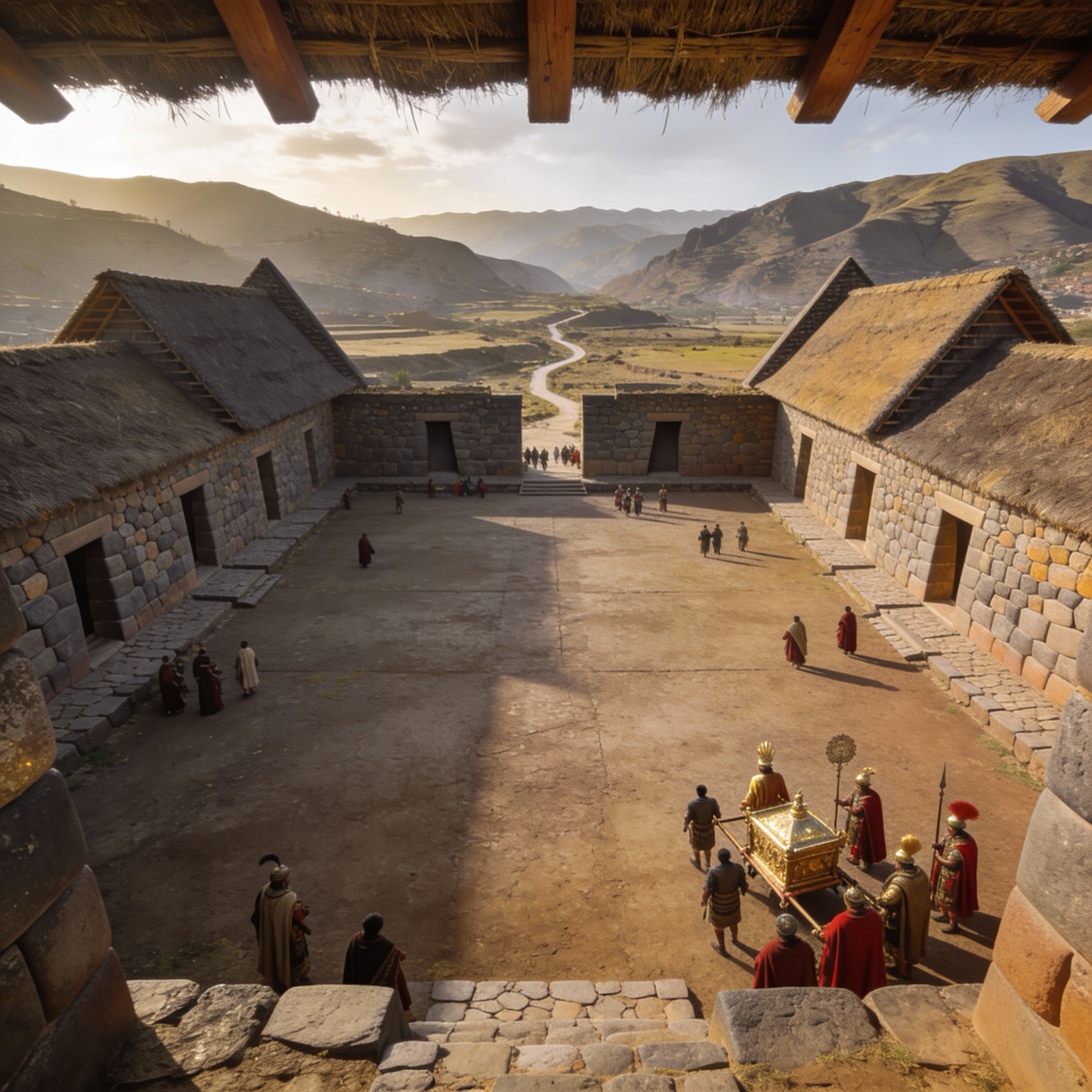
The square at Cajamarca was not made for war. It was not a parade ground but an open ceremonial space, flanked by low buildings and stone gateways. Receptions, rituals and solemn audiences were held there. On that afternoon of 16 November 1532, the place was ready for a display of power, not for a battle. That apparently minor detail would prove decisive.
Atahualpa had won the civil war only a few weeks earlier. Huáscar was a prisoner. The northern generals—Quisquis and Chalcuchímac—controlled the approaches to Cuzco. The Empire had suffered, but the Inca felt secure.
When he received news of the foreigners, he did not see a strategic threat. He considered them an anomaly: a small group of men with no kin, no ayllus, no recognisable gods. In Andean logic, that made them politically irrelevant.
That is why he decided to receive them in person at Cajamarca. Not as an enemy. Not as an equal. But as absolute lord.
Francisco Pizarro understood from the outset that he could not fight the Empire in open battle. He had neither the men, nor the supplies, nor the time. But he did have something the Inca did not know: shock warfare, terror and disorganisation.
On the night of 15 November he gathered his captains:
- Hernando Pizarro
- Hernando de Soto
- Gonzalo Pizarro
- Sebastián de Benalcázar
He did not speak of battle. He spoke of capture.
The plan was simple and reckless:
- Draw the Inca into the square
- Hem him into an enclosed space
- Cause panic
- Take him alive
All their lives depended on the Inca not dying in the chaos.
Atahualpa entered Cajamarca as evening fell. He did so according to imperial ritual: carried on a litter, surrounded by nobles, priests, musicians and servants. He wore symbols of victory. He carried no weapons, and neither did his immediate retinue. The troops—tens of thousands—remained camped outside the city.
It was not recklessness. It was cultural consistency. In the Andean world, a diplomatic meeting was not an ambush. Violence had rules. The gods were watching.
The Spaniards, hidden in the gateways, barely breathed.
The friar Vicente de Valverde stepped forward with an interpreter. He spoke of one God, of the true faith, of the authority of Emperor Charles V. None of this had an exact translation in Quechua. The speech was not understood, nor could it have been. When the book was rejected—perhaps thrown, perhaps simply dropped—Valverde ran back shouting that the Inca had blasphemed. It was the signal.
The outbreak
The roar of the arquebuses shattered the silence. For the Incas, that sound had no precedent. It was neither thunder nor drum. It was something new, incomprehensible, paralysing. Immediately afterwards, the horses burst into the square. They had never seen one. They believed man and beast were a single being, a monstrous creature. Panic spread instantly. There was no time to organise. There were no orders. There was no coordinated resistance.
The Spanish infantry attacked with steel against unarmed bodies. It was not an even fight. It was a chaotic, brief and brutal slaughter. In the midst of the chaos, Pizarro pushed towards Atahualpa. He shielded the Inca's body with his own. He shouted desperate orders not to kill him. Because he knew something essential: if the Inca died there, they would all die afterwards.
Atahualpa was dragged from his litter. Within minutes, the son of the Sun was a prisoner. The political, religious and symbolic axis of the Empire had been captured by fewer than two hundred men.
There was no pursuit afterwards. There was no classic military victory. The battle ended the very moment Atahualpa was seized.
The captivity of the Sun (1532–1533)
Atahualpa was a prisoner, but the Empire still revolved around him. Confined in Cajamarca, the Inca was not treated as an ordinary captive. He kept his retinue, servants, wives and advisers. He slept on fine blankets, ate according to court rituals and was carried on a litter within the compound. For the Andean world, the Inca could not cease to be Inca as long as he breathed. His capture had been a political disaster, but not a symbolic annulment.
From his prison, Atahualpa went on governing. He issued orders that were obeyed. The chasquis still crossed the Empire with messages sealed by his authority. The generals Quisquis and Chalcuchímac awaited instructions in different parts of the territory. The machinery of state, though bewildered, had not dissolved.
Atahualpa watched the Spaniards with growing attention. He soon understood that they were not gods but men driven by ambition, fear and internal rivalries. He also noticed their fascination with gold. In the Andean world the metal was sacred but not economic; its value was ritual, solar. For the Spaniards, by contrast, it was pure power, measurable and portable.
From that difference came the largest ransom known until then. At the end of November 1532, Atahualpa offered to fill a room with gold up to the height of his raised hand—some two and a half metres—and two more rooms with silver. Francisco Pizarro accepted. Over the following months, the Empire was literally emptied of its symbolic wealth. Endless caravans arrived from Cuzco, Quito, Pachacámac and dozens of ceremonial centres.
Sacred idols were torn from the temples. Gold plates that covered walls were stripped away. Ritual vessels, funeral masks and sun discs accumulated over generations ended up in makeshift furnaces. The cultural destruction was irreparable. Europe would never see those works.
The ransom was paid. But fear grew. The Spaniards feared a general uprising. They knew they were few. They knew the Empire could crush them if it regained the initiative. Moreover, Atahualpa remained a political problem: no alternative Inca would be legitimate while he lived.
The news of Huáscar's murder, ordered by Atahualpa to eliminate his rival, was decisive. In Spanish eyes, it confirmed how dangerous he was. In Andean eyes, it showed he was still exercising power.
The trial was swift, formal and deeply incomprehensible to the indigenous world. He was accused of idolatry, fratricide, conspiracy and treason. On the night of 26 July 1533, Atahualpa was executed after accepting baptism.
The son of the Sun died. The axis of the Andean world was broken.
The road to Cuzco (1533)
After Atahualpa's death, the Empire hung in a void. For weeks no one knew who was really in command. The Inca generals hesitated. Regional curacas weighed the risks. Many peoples subjugated for decades by the force of the Inca State—the Huancas, Cañaris and Chachapoyas—saw in the Spaniards a long-awaited opportunity.
The advance on Cuzco was no simple victory march. It was a succession of negotiations, forced pacts, threats and minor battles. Along the way there were clashes with forces loyal to Atahualpa and with garrisons that refused to recognise any new Inca.
The Spaniards advanced along the Qhapaq Ñan, the great imperial road network. Never had a state's infrastructure so eased an enemy's penetration. Every stocked tambo, every maintained suspension bridge, was a legacy that now worked against the world that had created it.
Pizarro understood that he needed an Inca, not as a real sovereign but as an instrument of legitimacy. He chose Manco Inca, a young member of the Cuzco royal family, of legitimate blood and restrained ambition. Manco accepted. Not out of conviction, but to survive.
Cuzco: the motionless city (November 1533)
The entry into Cuzco was not violent. It was silent. In November 1533 the Spaniards walked through the streets of the sacred capital and found a city intact, almost expectant. There were no ruins or fires. The cyclopean walls still stood, fitted together with a perfection that astonished even the European veterans. The Coricancha, temple of the Sun, still dominated the city. Although much of its gold had been stripped, the building kept an evident symbolic force. The Spaniards realised they were facing not barbarism but a fully developed civilisation.
But European imperial logic was different. The houses of the Inca nobles were shared out among the conquistadors. The temples began to be consecrated to Christian worship. Political power passed into the hands of the newcomers. Manco Inca was crowned as sovereign under Spanish tutelage.
For a short time it seemed the new order might stabilise. But beneath the surface, tension grew. The abuses of some Spaniards, the demands for tribute and the daily humiliation of the Inca nobility eroded any chance of coexistence. Manco watched. He learned. He waited.
The new order (1533)
The military conquest had been swift. The transformation would be long and painful. In the following years, towns were founded on the Castilian model. Notaries, clergy and officials arrived. Castilian law, coinage and written records were introduced. But there were also marriage alliances, sincere conversions and strategic conversions, and mutual adaptations.
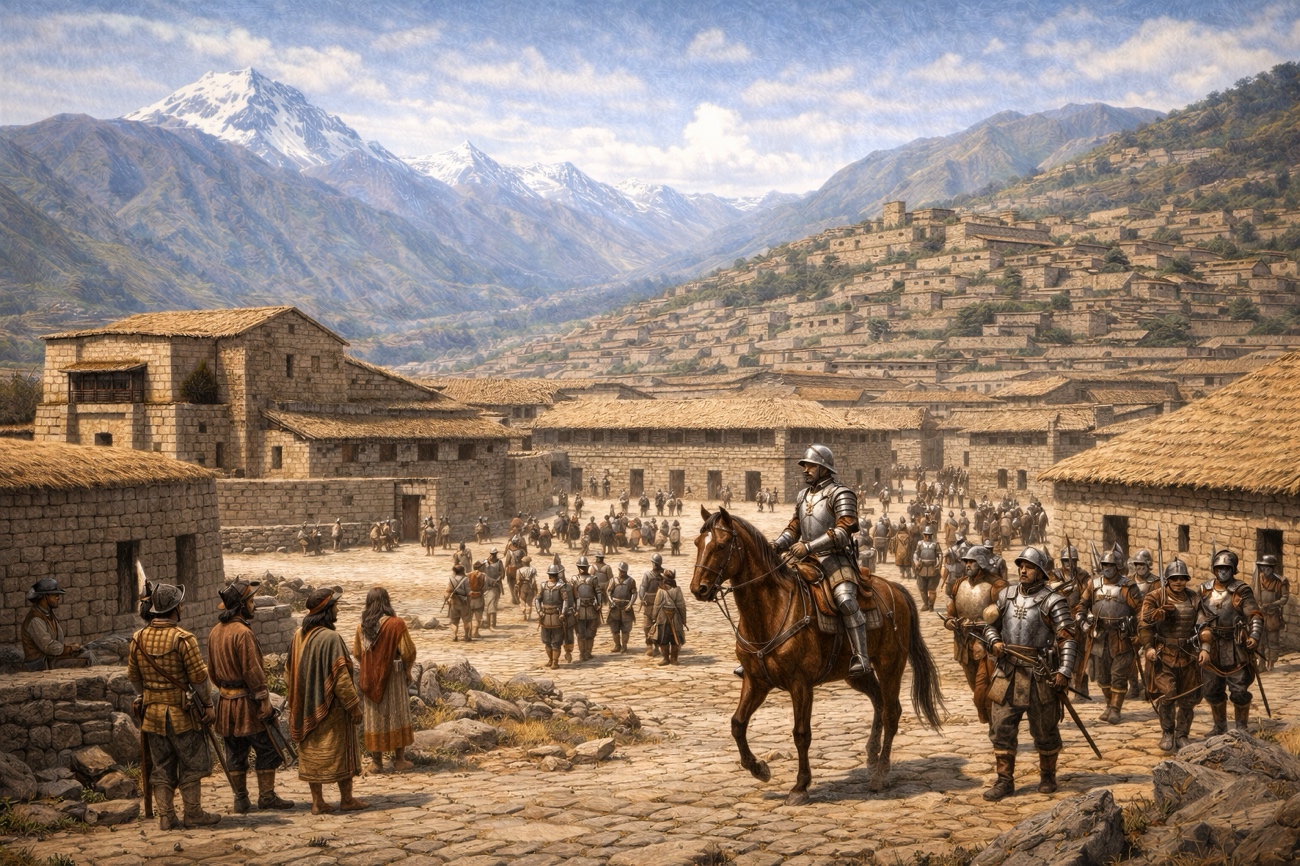
The resulting society was not simply imposed. It was a process of conflictive fusion. Quechua languages coexisted with Castilian. Old beliefs hid beneath Christian forms. The Andean world did not disappear: it was transformed.
But the wound remained open. The seed of rebellion had been planted. In 1536 Manco Inca would rise against the Spaniards and besiege Cuzco with tens of thousands of warriors. The conquest, far from over, would then enter its bloodiest phase.
