
1521-1600: The Creation of New Spain
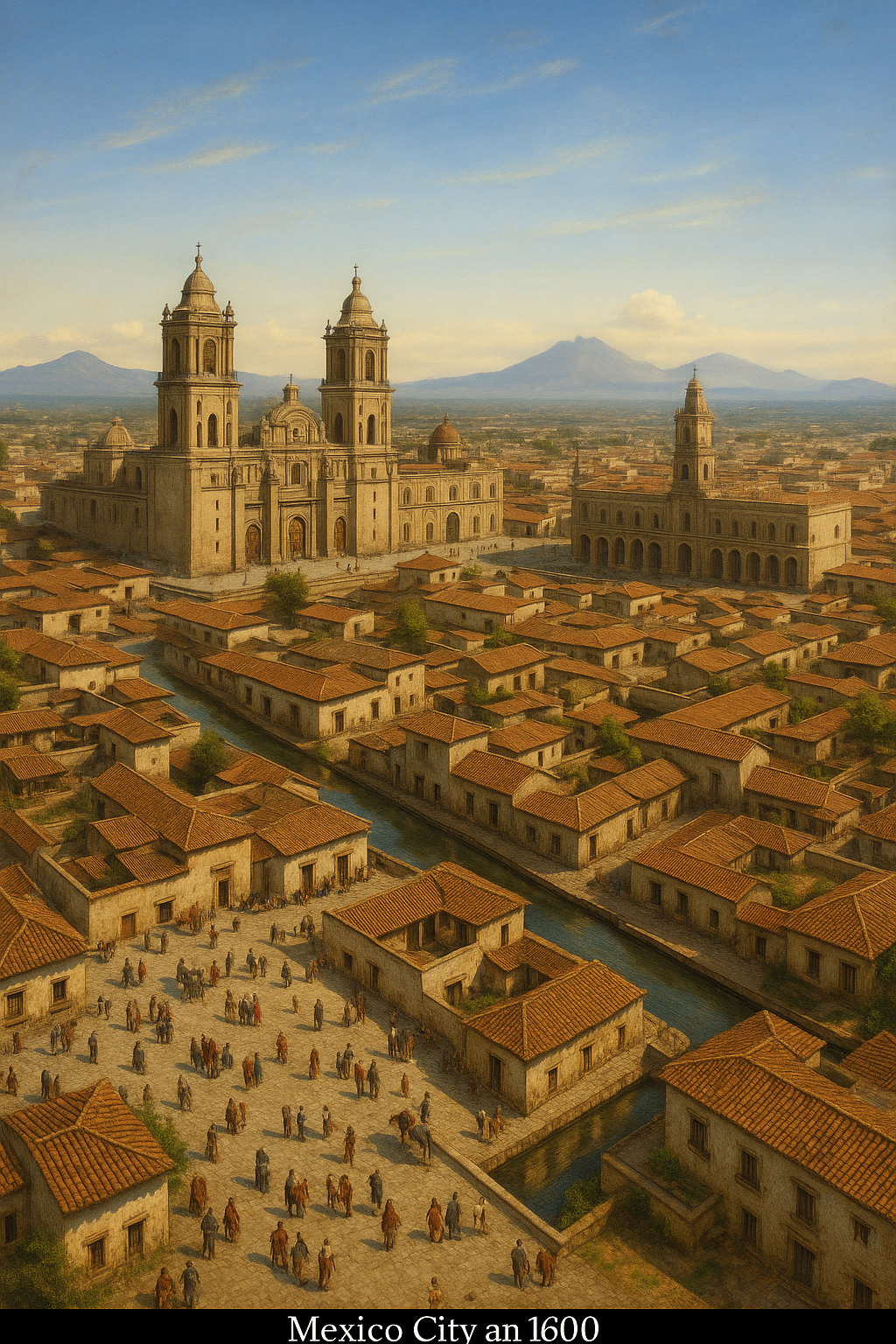
When Tenochtitlan fell on 13 August 1521, the city lay in ruins. The chronicles speak of tens of thousands of bodies in the streets and canals. Of the 200,000 to 250,000 inhabitants the Mexica capital is estimated to have had at its height, only between 30,000 and 40,000 survived the siege, weakened by hunger and by the smallpox epidemic that had struck since 1520.
The first years were a state of emergency. Between 1521 and 1523, Cortés and his men occupied the remains of the palace of Axayácatl and some stone houses that had survived. The surviving Mexica were moved to outlying districts, above all Tlatelolco, which became the main indigenous core of the new city. The city lay silent, covered in rubble and stench, but for Cortés it remained the strategic site: the capital of New Spain had to rise on that island.
In 1524 the master builder Alonso García Bravo was ordered to design the new layout. With square and cord he marked out a grid plan in the Castilian style. The centre of the old city—the sacred precinct with the Templo Mayor—was demolished and turned into the Plaza Mayor, the heart of the new Mexico City. A provisional church was built on the stones of the temple, the origin of the future Metropolitan Cathedral.
Between 1524 and 1530 the city began to take shape:
- Houses for the conquistadors were built with reused stone.
- Work began on Franciscan and Dominican convents, which would become centres of evangelisation.
- The Chapultepec aqueduct was rebuilt in 1530 to supply water to the public fountains.
Trade soon revived. The Tlatelolco market, which according to Bernal Díaz del Castillo could gather up to 40,000 people in a single day, once again became a centre of exchange, now watched over by Spaniards but supplied by thousands of indigenous people.
Between 1530 and 1550 the rebuilding accelerated:
- The great convents (San Francisco, Santo Domingo, San Agustín) were consolidated.
- The Viceroys' Palace was built on one side of the Plaza Mayor.
- The cathedral began to grow in size and ambition, although the complete work would take more than a century.
By 1550, barely 30 years after the fall, Mexico City already had some 40,000 to 50,000 inhabitants, most of them indigenous, although the numbers of Spaniards, criollos and Africans were rising. The city had been reborn as a viceregal capital, the political and economic centre of all New Spain.
By 1600, with more than 100,000 inhabitants, it was one of the largest and richest cities in the world, comparable to Seville or Lisbon. What had been Tenochtitlan no longer existed, but on its foundations stood a new city, mestizo, a blend of two worlds.
The birth of a new society
When Tenochtitlan fell in 1521, the city collapsed not only into stones and ashes but also in its social structure. The great lords, the warriors, the priests of the sun and moon saw the world they knew come crashing down. But life did not die out: from the ruins, the survivors adapted to a new order that arrived with armour, crosses and banners.
In the early years, between 1521 and 1530, power rested on a fragile balance. The Spaniards were few, barely a few thousand against millions of indigenous people. They needed the old Mexica nobles to administer the common people, who now paid tribute to the Crown and to the encomenderos. The indigenous nobility kept titles, chiefdoms and lands, but no longer in the name of Huitzilopochtli or Moctezuma, but in the name of the King of Castile.
By the mid-1530s the city began to fill with friars: first Franciscans, then Dominicans and Augustinians. Evangelisation was on a massive scale. In the courtyards of the new convents, thousands of indigenous people heard the stories of Christ and the Virgin in Nahuatl. The friars banned sacrifices but allowed many festivals to continue, now with saints instead of gods. In those same spaces schools were founded where the sons of the nobility learned to read and write in Castilian and Latin. It was the beginning of a mestizo culture, still in its infancy.
By 1550 society had changed its face. At the top were the Spaniards, holders of offices, trade and land. Their children born in New Spain—the criollos—were beginning to take up more and more space. In the middle, a new people was emerging: the mestizos, children of Spaniards and indigenous people, who fitted into neither world but were beginning to multiply in trades, crafts and commerce. At the bottom remained the indigenous majority, the macehuales, who went on sowing maize, paying tribute and adapting to the new forms of faith. More and more African slaves were also arriving through the ports, joining this diverse and hierarchical society.
By around 1600 the transformation was plain to see. Mexico City, built on the remains of Tenochtitlan, already had more than 100,000 inhabitants, one of the largest cities in the world. In its streets the ringing of bells mingled with the murmur of Nahuatl; the markets of Tlatelolco were still packed with maize, cacao and flowers, but now under the watch of Spanish corregidores; religious processions mixed crosses and Virgins with dances and flowers from ancient times.
The society of New Spain was no longer Mexica or Spanish: it was something new, a mestizo fabric. The Spaniards ruled, the criollos grew, the indigenous people adapted, the Africans laboured and the mestizos, ever more visible, wove the bonds of a different identity.
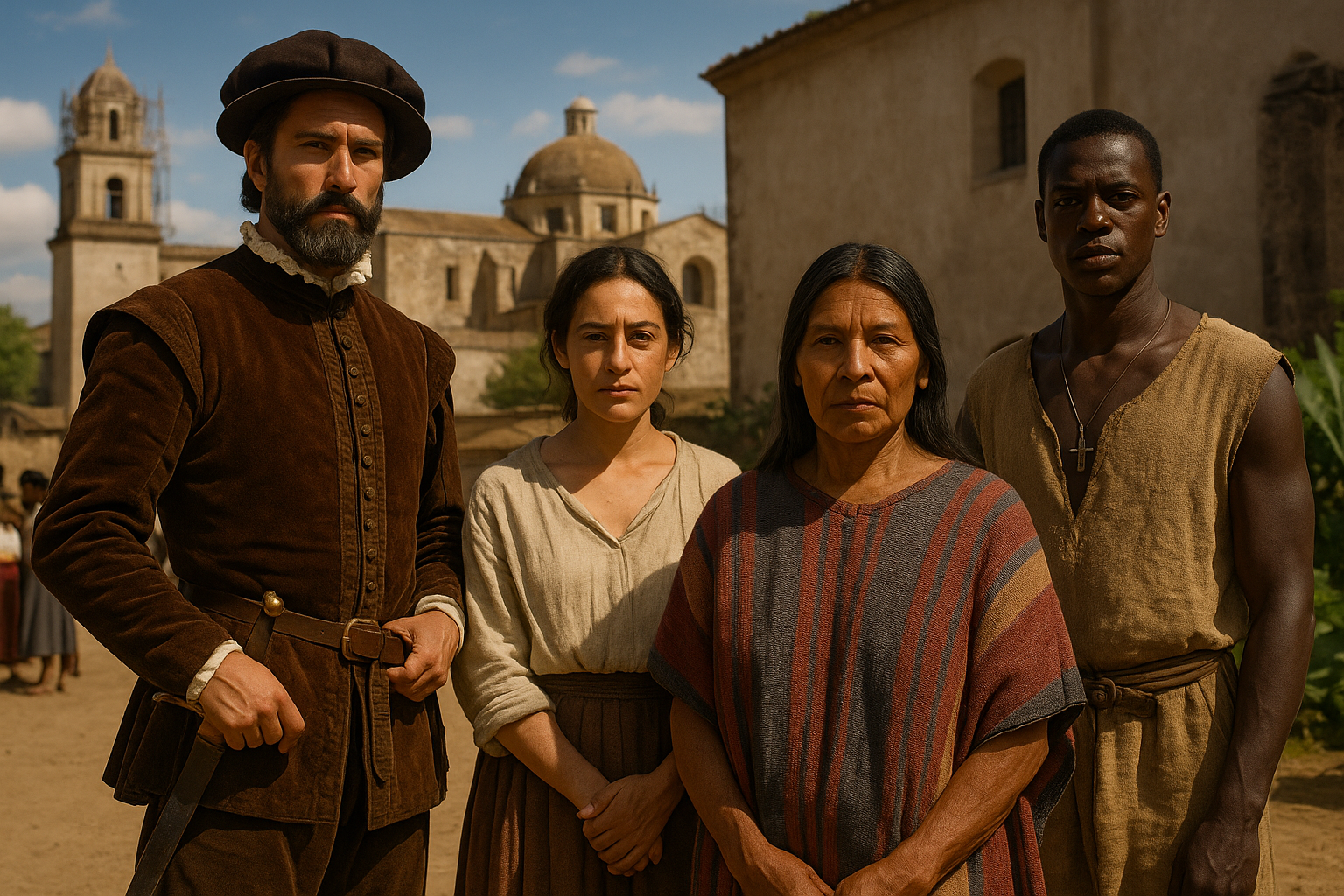
In less than eighty years, what had been the heart of an indigenous empire had become the heart of a viceroyalty, and with it was born a mestizo society that would shape the Mexico of New Spain.
The initial catastrophe and the recovery of the population
On the eve of Cortés's arrival, around 1519, the heart of Mesoamerica was beating strongly. The Mexica Empire, through the Triple Alliance (Tenochtitlan, Texcoco and Tlacopan), extended its influence over a vast territory of the central highlands, the Gulf coast and part of southern Mexico. Chroniclers and modern studies estimate that the population of these regions was somewhere between 15 and 20 million people, with Tenochtitlan as the jewel of the lake, home to 200,000 to 250,000 inhabitants, one of the largest cities in the world at the time.
The chinampa fields of Xochimilco produced maize and flowers for hundreds of thousands; Tlaxcala, with some 150,000 inhabitants, stood proudly in constant war against the Mexica; Cholula, with more than 100,000 souls, was a religious and trading centre; Michoacán, the Purépecha kingdom, had nearly 250,000 inhabitants in its capital Tzintzuntzan and surrounding area; and the Mixtec and Zapotec regions of Oaxaca together numbered almost half a million people. It was a dense and vibrant mosaic of peoples, markets and cities.
But with the war came catastrophe. The smallpox of 1520, followed by new epidemics of measles (1531) and typhus (1540), struck populations with no natural defences. The fall of Tenochtitlan was only the beginning: between 1520 and 1550 whole villages disappeared, fields were left empty and markets fell silent.
By the middle of the sixteenth century the population of New Spain had fallen to some 4–5 million, barely a quarter of what it had been thirty years earlier. And by 1600 the figures were even more dramatic: only 2 to 3 million indigenous inhabitants survived in the area that a century earlier had been home to more than 15 million.
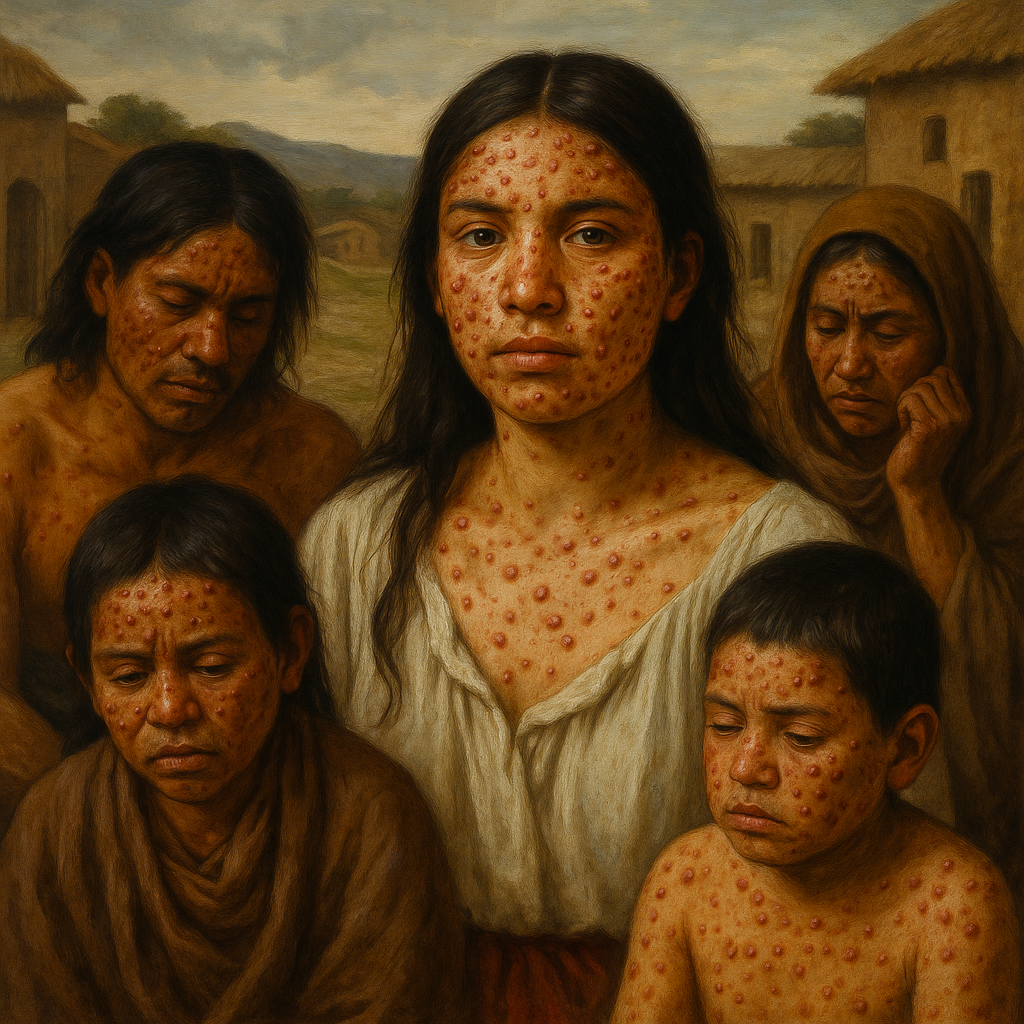
Tenochtitlan, reduced to rubble in 1521, became Mexico City, which by 1600 had more than 100,000 inhabitants, now a mix of Spaniards, criollos, indigenous people, mestizos and Africans. Tlaxcala, the proud ally, had lost more than half its population to epidemics but kept its prestige. Cholula, Texcoco and Coyoacán became secondary towns, integrated as tributary communities. Michoacán and Oaxaca also saw their numbers collapse, although their nobles were incorporated as caciques in the service of the Crown.
The human mosaic had changed: what had been an almost entirely indigenous world of some 15–20 million people became a society of barely 2–3 million indigenous people, reinforced by some 150,000 Spaniards and criollos, tens of thousands of mestizos and an African population that was beginning to be significant in the cities and haciendas.