The Carib People
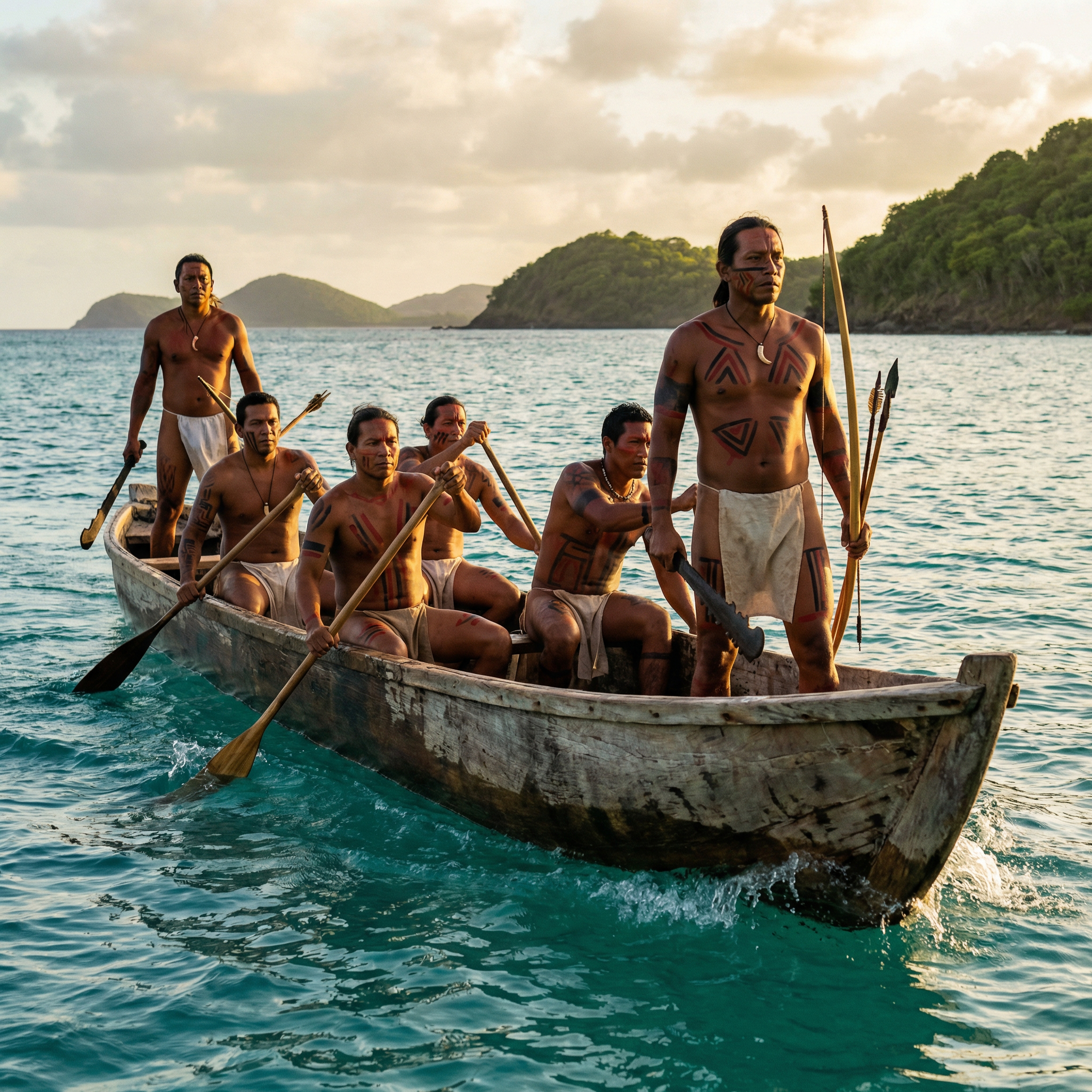
The Caribs, also known as the Kalinago, were an indigenous people who lived in northern South America and the Lesser Antilles before and during contact with Europeans in the fifteenth century. Their history is marked by a warlike spirit, a seafaring culture and a strong social organisation, which allowed them to spread across a vast territory and become one of the most influential civilisations in the region.
Social and political organisation
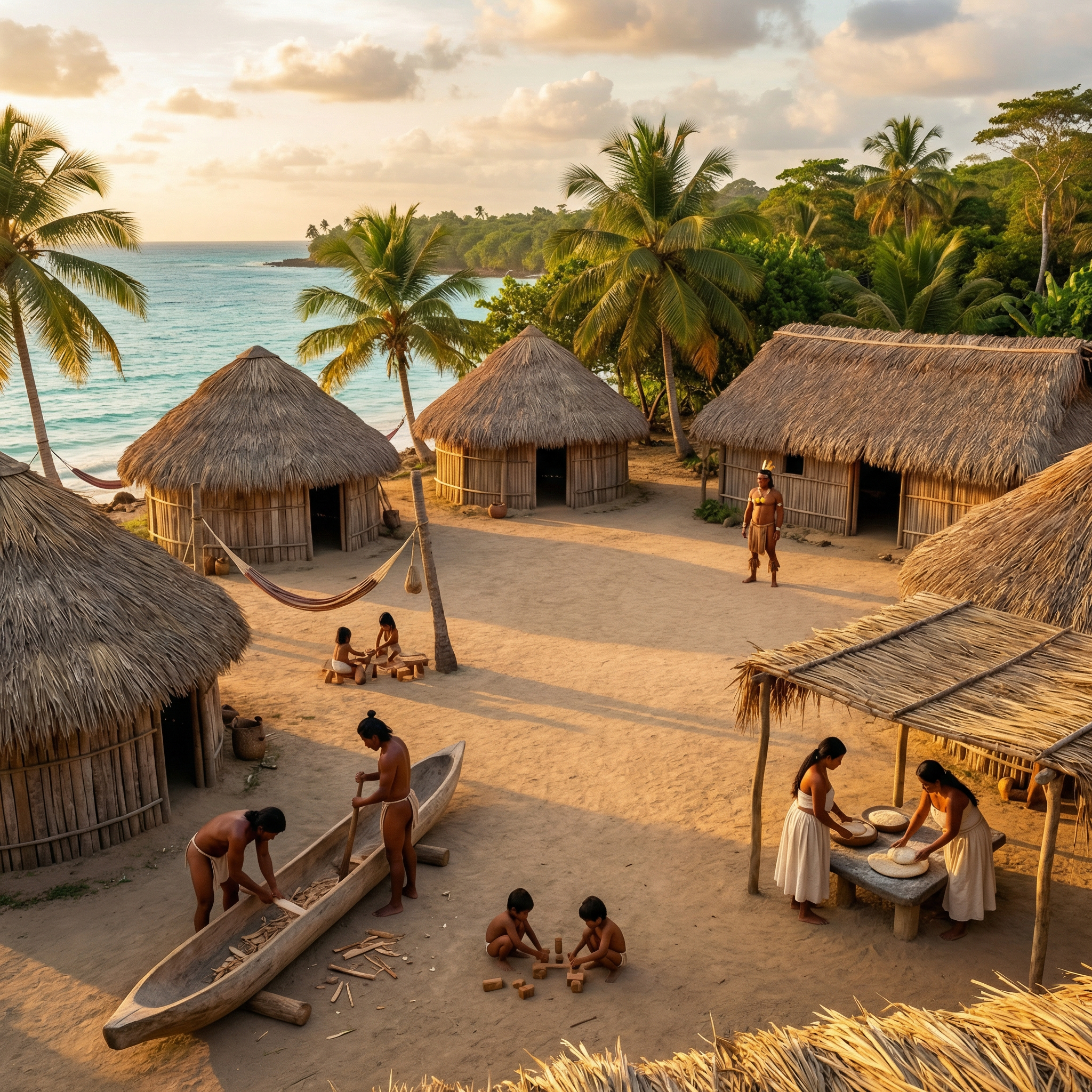
Carib society was structured in chiefdoms, political units based on patrilineal family clans that maintained alliances with other peoples. Although their system was largely hierarchical, the caciques governed with the support of councils of warriors and elders, ensuring the stability of their communities. Unlike other indigenous groups in the Caribbean, the Caribs did not settle in large villages but in scattered communities, with the dwellings set apart from one another. This arrangement allowed more privacy and made defence easier in the event of conflict.
Marriage was a key strategy in the spread of their culture. They practised male polygamy and exogamy—marrying outside their clan—which allowed them to build ties with other groups. In some cases these unions were the result of agreements between clans, while in others they arose from war, as the Caribs took the women of defeated peoples into their families, ensuring the continuity of the patrilineal line.
Housing and architecture
Carib dwellings reflected their close relationship with the natural environment. They built bahareques, rectangular structures that, though simple, were sturdy and suited to the region's climate. They used wooden piles for the foundations, walls of wild cane and guadua bamboo mats, and pitched roofs of palm leaves that protected them from sun and rain. They also coated the walls with a plant-based mortar and, in some cases, applied a final layer of lime to strengthen the structure.
They also used enramadas and windbreaks, lighter structures used as temporary shelters, while bohíos and churuatas were more elaborate buildings used for community gatherings or as larger homes.

Economy and livelihoods
The Caribs developed a diversified economy that combined fishing, farming, gathering and trade. Fishing was their main activity, as their mastery of the sea allowed them to catch both freshwater and saltwater species. To preserve food for long periods, they used techniques such as smoking, drying and salting.
Although fishing was fundamental, agriculture also played an important role. They grew a wide variety of crops, notably maize, cassava, cacao, tobacco, potatoes, chilli peppers and various tropical fruits. They also developed an efficient farming system that allowed them to obtain resources without drastically altering the ecosystem.
Trade was another pillar of their economy. They established exchange relations with other peoples, especially the Taíno, with whom they traded food, cotton and metals such as silver. Through these exchanges they acquired valuable goods and strengthened their presence in the region.
Art and cultural expression
The creativity and manual skill of the Caribs were reflected in their everyday objects and ceremonial ornaments. They were expert goldsmiths, making bracelets, pectorals and human figures in gold that had both decorative and ritual value. They also worked cotton and fique fibre to make textiles with geometric designs that identified their clans.
One of the most distinctive features of their culture was body painting, applied with plant and mineral dyes. These paintings were not only aesthetic; they also protected against insects and the weather and served as a symbol of identity and social status. Each design represented elements important to the community, such as totemic animals—notably the bat, the jaguar, the spider and the monkey—figures also common in other indigenous cultures of the Amazon region.
Religion and rituals
The Caribs had a worldview deeply tied to nature and to their ancestors. Their spiritual practices were led by shamans who, besides their religious duties, acted as leaders and guides in times of crisis.
One of their most deeply rooted beliefs was the protection of the ancestors. It was customary to keep the bones of deceased relatives inside the house, as it was believed their spirits would go on watching over the family. In the most important funeral rites, bodies were cremated and their ashes placed in gold chests, together with personal objects such as weapons, jewellery and food, so that the spirit would have everything it needed on its journey to the afterlife.
Taíno and Caribs: two peoples, a legendary conflict
The encounter between Europeans and the indigenous peoples of the Caribbean was marked by accounts that often exaggerated or distorted the realities of these civilisations. In his chronicles, Christopher Columbus described the Taíno as a peaceful people of "great simplicity and gentleness" who lived in fear of a group of fierce warriors: the Caribs. According to the Admiral, the latter were skilled archers, aggressive and cannibals, which helped create the image of the Caribs as a savage and dangerous tribe.
Columbus's chronicles relate that the Caribs kept human bones in baskets and hung heads and limbs in their houses. However, his description was based on indirect observation and on stories told by the Taíno themselves, who also had their own reasons for exaggerating the danger posed by their rivals. Moreover, the term Columbus used for them, "caniba", stemmed from a linguistic confusion: at the time it was believed that the inhabitants of Asia were subjects of the Great Khan, and Columbus thought he had reached lands near Asia. Later, Spanish explorers adapted the name to "Caribe", the term by which they would be known in history.
The Taíno and the Caribs were peoples with different ways of life and social structures. While the Taíno were mainly farmers and traders, with a more organised system of villages and chiefdoms, the Caribs were seafarers and warriors, with a more decentralised structure and constant mobility.
European accounts and Taíno oral tradition suggest that the Caribs raided Taíno communities, carrying off women and attacking the men. These actions have been interpreted as tribal warfare, common in many indigenous societies, where capturing women to bring them into the victorious community was a regular practice.
Cannibalism has been one of the most controversial issues in Carib history. Spanish accounts describe them as man-eaters, but there is no archaeological evidence to confirm these claims. Some researchers believe that, if the practice did exist, it may have been limited to war rituals or used as intimidation to strike terror into their enemies. The study of relations between the Taíno and the Caribs has evolved over time. Whereas it was once described as a clear conflict between a peaceful people and a violent one, today the reality is understood to have been much more complex. There were conflicts and rivalries, but also coexistence, cultural exchange and alliances through marriage.
Language and legacy
The languages spoken by the Caribs belonged to the Cariban family, which extended over large areas of South America. However, with the arrival of the Europeans and the disappearance of many indigenous communities, these languages were gradually lost.
In the Lesser Antilles, the Island Caribs (Kalinago) spoke a language of Arawakan origin, similar to that of the Taíno. Curiously, there was a linguistic distinction between men and women: while men used a creole language with Carib influences, women spoke an Arawakan language. This peculiarity has been interpreted as the result of the Caribs' conquest of the Taíno, although some modern historians consider this theory an oversimplification of the linguistic phenomenon.
Today the Garifuna language, spoken in Roatán and Honduras, is one of the last remnants of this linguistic tradition, with both Arawakan and Carib roots.
The arrival of the Europeans marked the decline of the Caribs in the Antilles, but their legacy lives on in their descendants, such as the Kariña of Venezuela and the Garifuna of Central America. Many words of Carib origin are also still used in place names and popular culture.
The Caribs were a resilient people: expert navigators, feared warriors and skilful traders.