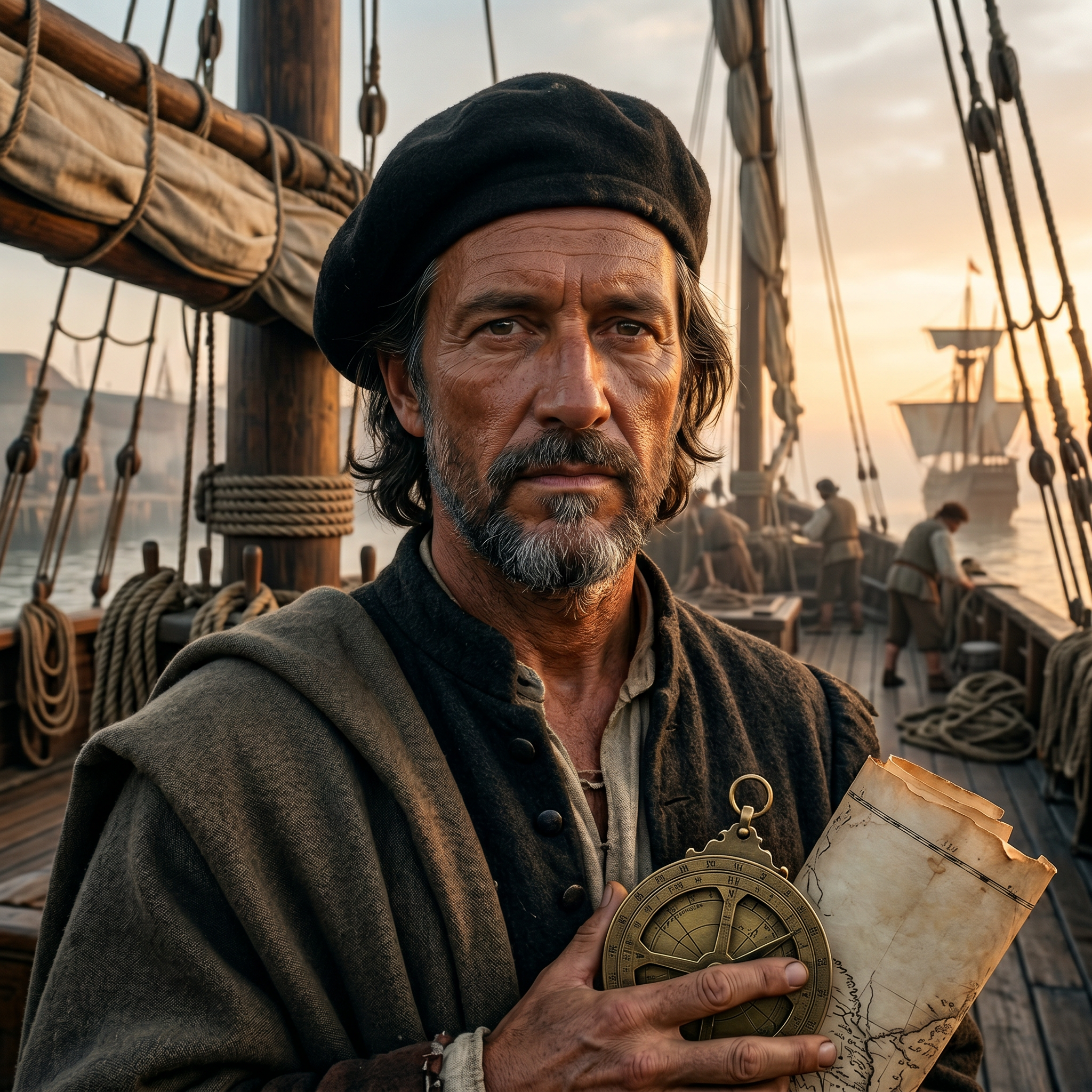
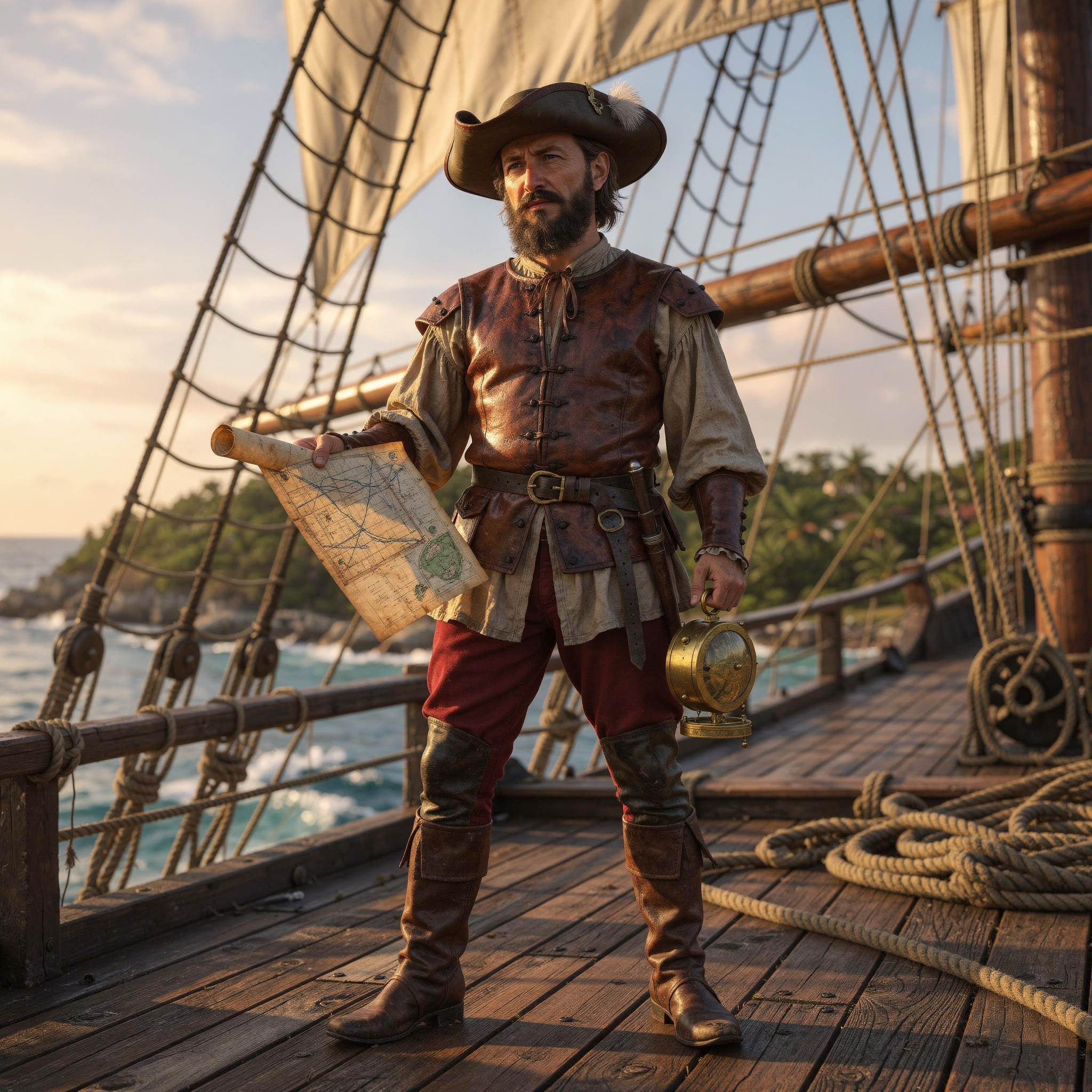
Vasco Núñez de Balboa Crosses the Isthmus of Panama and Discovers the Pacific Ocean
Born around 1475 in Jerez de los Caballeros, in austere Castilian Extremadura, Vasco Núñez de Balboa was one of many hidalgos of noble lineage but no fortune. Like so many others, he set off for the Indies in search of opportunity. After joining coastal expeditions and trying his luck raising pigs on Hispaniola—without success and with many debts—he ended up as a stowaway bound for the mainland in 1510, hidden in a barrel and accompanied by his faithful dog Leoncico.
In the wild lands of Darién, on the present-day border between Colombia and Panama, Balboa and other adventurers founded the town of Santa María la Antigua, the first stable settlement on the American mainland. He was appointed mayor and later governor, and showed a special talent for diplomacy with the indigenous peoples, military leadership and organisation.
Amid rumours of a great sea to the south and of lands rich in gold and pearls, he decided to find out for himself whether those legends were true. Thus began an unparalleled feat that would forever mark the history of the Americas.
The march into the unknown
It was September 1513. Balboa, convinced that there was a sea on the other side of the isthmus, organised an expedition of 190 men, accompanied by indigenous allies, guides and naborías (native servants). They set out from the port of Careta, near Santa María, plunging into the relentless thickness of the tropics.
The column moved slowly, through torrential rain, dense jungle, swamps and steep mountains. They carried arquebuses, swords, crossbows, trained dogs and even horses, but also provisions, axes, tools, religious images and the banners of Castile.
During the first days they crossed friendly territory, such as that of the cacique Fernando Careta. Then they reached the lands of Ponca, whose lord, after initially resisting, offered provisions and guides. They continued over increasingly rugged terrain until they came up against the cacique Torecha of Quareca, who did give battle. After a brief fight—uneven, given the superiority of Spanish weapons—the natives fled, and Balboa's men camped there for several days.

It was then that they were shown a summit from which, according to the guides, the great sea could be seen.
Balboa ordered the group to halt. He wanted to be the first.
The discovery
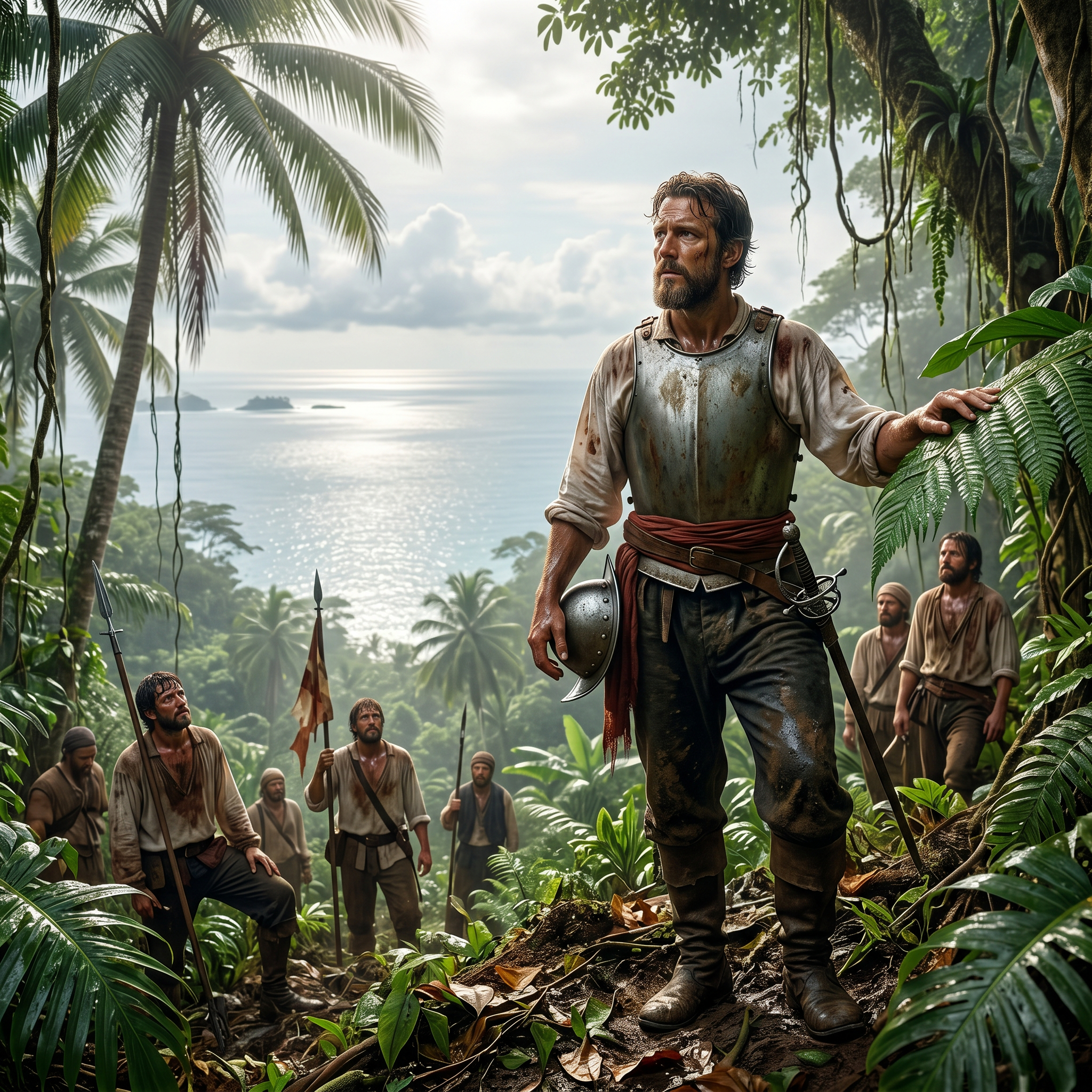
On the morning of 25 September 1513, Vasco Núñez de Balboa made the final ascent alone. Clad in his armour, sword at his belt and the standard of Castile in his hand, he climbed the rain-soaked slope until he reached the top. There, amid the silence and the mist, he saw the Pacific Ocean for the first time.
He held his breath. At his feet stretched an immense sea, calm and dazzling. His first gesture was to kneel and give thanks to God. Then, raising his sword, he took possession of the new sea in the name of the Monarchs of Castile, as the ritual required.
His men caught up with him shortly afterwards. They had crossed the isthmus in just four weeks, a record given the conditions, and without losing a single soldier. They spent the night in camp and began the descent towards the coast.
On 29 September, the feast of Saint Michael, they reached an inlet of the Gulf of San Miguel. Balboa waited for the tide to come in and, in full armour, solemnly waded into the water up to his knees, brandishing the standard.
"In the name of God and of the Catholic Monarchs, I take possession of these waters and all the lands they bathe!"
The chronicles say his companions burst into cheers. Leoncico, his dog, barked loudly, wearing a gold collar.
Beyond the sea: pearls and promises
He did not stop there. In the following days, Balboa explored the lands near the Pacific. They visited the villages of Chapé, Cuquera and Tumaco, where they found gold, pearls and slaves. It was then that they heard of some islands in the southern sea: the Pearl Islands.
With the help of indigenous guides, they set out in canoes and reached the island he named Isla Rica (today Isla del Rey in the Pearl Islands archipelago), where they saw oyster fishermen with paddles inlaid with pearls. They drew up several acts of possession, gathered testimony and plunder, and set off back by a different route to discover new lands.
The return journey was hard: fevers, rain, hunger and a sick Balboa carried on a litter. Nevertheless, on 4 January 1514 the expedition arrived back at Santa María with more than 2,000 pesos in gold and pearls and new knowledge of the continent. Above all, they brought back a historic truth: America had two oceans, and Balboa had been the first to see them from the mainland.
A shadow on the horizon
But glory does not always protect its owners. Later, in 1514, King Ferdinand sent Pedro Arias de Ávila (Pedrarias) as the new governor of Darién. Old, suspicious and jealous of Balboa's fame, Pedrarias distrusted him from the very start—even though he eventually promised him his daughter María in marriage as an act of diplomacy, making Balboa his son-in-law.
Although the king appointed him adelantado of the South Sea and governor of the provinces of Panama and Coiba, Balboa was never able to exercise these offices. Pedrarias isolated him, denied him resources and kept him under watch. When Balboa tried to organise a new expedition to explore the southern Pacific—perhaps even towards the lands of the future Peru—the governor laid a trap.
Accused of treason and usurpation, Balboa was arrested in 1518. For weeks he was held in a wooden cage under the direct watch of his father-in-law. A rigged trial with no possibility of appeal sentenced him to death.
On a day between 13 and 21 January 1519, in the square of Acla, he was beheaded along with his most loyal companions. No resident dared to defend him. The executioner held his head up to the crowd while the town crier shouted: "This is the justice ordered by the King our Lord…".
The legacy
Vasco Núñez de Balboa died as he had lived: with dignity, courage and vision, betrayed by the pettiness of his time. Discoverer of the largest ocean on the planet, he never knew that this sea would be called the Pacific, nor that his route would mark the beginning of new epics, such as the Magellan-Elcano circumnavigation, which set out that same year.
His figure is a symbol of a conquest in which ambition, diplomacy and tragedy coexisted. A pioneer, a different kind of coloniser, who preferred alliances to massacres and who dreamed of joining two worlds as he gazed at the horizon.
From that summit, his gaze still searches for the unknown.