The First Mestizos of Spanish America

Long before the great cities of the American continent filled with mixed accents and diverse faces, mestizaje—the mixing of peoples—was already a reality in the first years of the Spanish presence in the Americas. This phenomenon, defined by the close and profound encounter between Europeans and indigenous people, had discreet, almost domestic beginnings, first appearing in small villages in the Caribbean. At the same time, in the thick forests of Yucatán, an extraordinary story unfolded that symbolises the birth of mestizaje on the continent.
What follows is how the first "new blood" of Spanish America came about, through stories of shipwrecks, alliances and lives shared between two worlds.
1. Hispaniola: where it all began
In 1493, with Columbus's return to the Americas, Hispaniola—inhabited by the Taíno—became the centre of coexistence between the new Spanish settlers and the indigenous communities. Unions soon arose between European men and indigenous women, driven by necessity, affection or alliance, joining two worlds that still eyed each other warily.
The first mestizo child (1493)
The union of Pedro Gutiérrez, steward of the Royal Household, and a Taíno woman led to the birth of the first recorded mestizo in American history. Although the child died very young, his existence marks the beginning of genetic intertwining on the continent.
Miguelico (1496): the boy who grew up between two cultures
A few years later Miguelico was born, the child of Miguel Díaz de Aux and the indigenous woman Catalina. Raised in the first settlements, he appears in documents from 1504 as a strong and lively boy, fully accepted as part of the family. His life represents one of the first real experiences of a dual cultural heritage.
Don Fernando (1497–1498): the first fully documented mestizo
Later, Don Fernando, son of Miguel de Pasamonte and a Taíno woman from La Isabela, was acknowledged and educated by his father. His existence is documented in deeds, and he is remembered as the first mestizo whose life was fully recorded in history.
In those years, the shortage of European women in the Antilles made unions with Taíno women natural and frequent. Mixed families emerged as part of everyday coexistence, thus inaugurating mestizaje in Spanish America.
2. Yucatán: the other story, one that seems like a myth
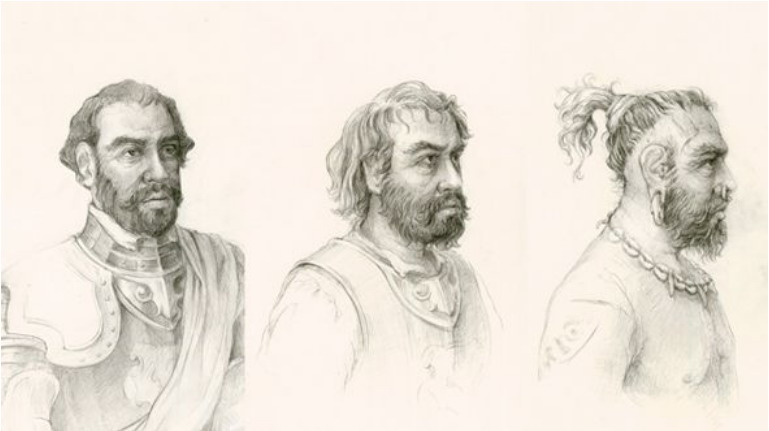
While mestizaje was taking hold in the Caribbean under Taíno influence, a different story was unfolding in the Maya jungle of Yucatán. In 1511, after a Spanish ship was wrecked near the coast of Yucatán, Gonzalo Guerrero, one of the survivors, underwent a transformation that made him a symbol of mestizaje.
The Spaniard who chose to stay
Captured by the Maya, Guerrero learned their language, adopted their customs and became a warrior and military leader in Chactemal. There he married Zazil Há, the daughter of a Maya ruler, becoming fully part of the community.
The first mestizo family within the indigenous world
The children of Guerrero and Zazil Há grew up as Maya: tattooed, strong and trained in traditional weapons. The chronicles describe the Spaniards' astonishment at seeing fair-skinned, fine-haired young men confronting them from canoes, completely integrated into Maya culture. They were the first mestizos fully accepted in an indigenous society, bearers of a dual heritage that was not only biological but also cultural.
3. The paths of mestizaje
The question of who was the first mestizo in the Americas has no single answer; it reflects a range of human stories:
- The first mestizo birth, documented in 1493.
- The first child to grow up in that blend, Miguelico.
- The first fully documented mestizo, Don Fernando.
- The family of Gonzalo Guerrero, a symbol of mestizaje as destiny rather than accident.
Each of them represents a different root of Spanish American mestizaje: the initial mixing in the Antilles, family continuity, social integration and deep cultural fusion.
4. How the mestizo identity of Spanish America was born
Mestizaje did not arise as a programme or a deliberate strategy, but as the sum of many lives: that of a Taíno woman who loved a man who came from the sea, of a child who grew up hearing two languages, of a Spaniard who chose to live as a Maya, and of children who embodied a synthesis never before seen on the continent.
Five centuries later, Spanish America is a vast territory shaped by that blending, which no longer belongs to two peoples alone but to millions. There lie the roots of a mestizo Gran Patria, born of encounter, wonder, conflict and also love.