
The Santa Hermandad in Spanish America
When the night had an owner
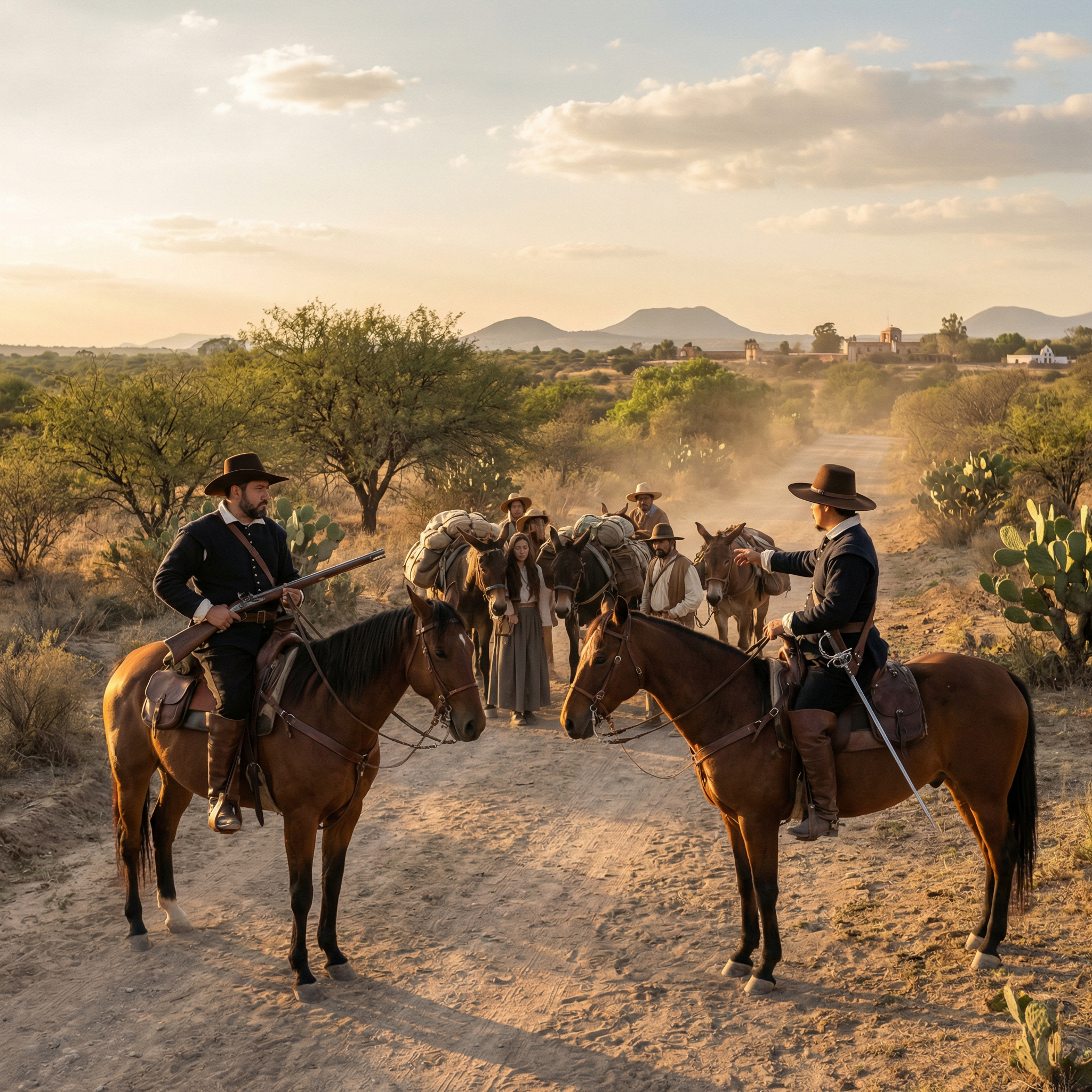
On the old roads linking Mexico City with Veracruz, before there were stagecoaches or royal guards to keep travellers safe, the night belonged to a cast of figures: highwaymen, bandits, desperate muleteers, rebellious natives and fearful travellers who prayed as they made their way through the darkness. In this setting one group stood out: men dressed in coarse cloth and armed with lances, officially known as the Santa Hermandad (Holy Brotherhood). People nicknamed them "los verdes" (the green ones) for the colour of their clothes, dyed with local herbs. They were not often seen, but the mere mention of them brought a sense of safety, for their reputation as guardians of the roads went before them.
The Mexico City patrol (1574)
In 1574, according to the town council's notary, the Santa Hermandad of Mexico City numbered thirty-three men under the command of Captain Hernando de Ávila. Their mission was to patrol the route from Chalco to Texcoco, pursuing the highwaymen who threatened the region. Among the outlaws, one stood out: a mestizo nicknamed el Zorrito de Chalco (the Little Fox of Chalco), known for his cunning. One damp night, by the light of fireflies, the Hermandad, guided by an indigenous tracker who had spotted fresh footprints, crept silently up to a clearing in the woods. There the Zorrito, seeing the green and black lances, chose to surrender peacefully. Although the capture was only briefly noted in the official records, for the muleteers it was cause for celebration, as it meant the return of safety to the roads.
The mud trackers (1605)
In 1605, three Augustinian friars travelling to Tiripetío, in Michoacán, were attacked by a group of indigenous highwaymen. Tied up and stripped of their belongings, the friars were taken towards a ravine. At that moment the sound of hooves announced the arrival of the Santa Hermandad of Valladolid, led by Captain Pedro Hernández. Skilfully, Hernández and his squad followed the tracks to a stream, putting the bandits to flight and freeing the friars. In gratitude, the Augustinians presented the captain with a black cloak of fine cloth, which became a symbol of leadership within the Hermandad. Friar Diego de Basalenque recounted the episode, stressing the Hermandad's ability to read footprints as if they were written letters.
The riderless horse (1642)
In 1642, near Puebla, a rumour spread of a mysterious white horse that roamed the Tepeaca road attacking travellers. Some thought it a spirit or a demon, and it was said to neigh in a strange tongue. Faced with complaints, the town council asked the Santa Hermandad to intervene. During the night, the squad followed the animal's trail until they discovered that the supposed "ghost" was a horse trained by a bandit, who controlled it with hidden ropes while he robbed travellers. The thief was unmasked when the horse itself, confused, threw him to the ground, and the case was recorded in the General Archive of the Nation.
A small but decisive institution
The Santa Hermandad was never a large or well-paid body. In Mexico City the group usually had between thirty and forty men, while in mining areas it numbered barely a dozen and in villages rarely more than ten. Despite its size, its work was essential, turning dangerous roads into safe, passable routes. They were not soldiers in the direct service of the king, but local residents organised by the town councils, who knew the terrain and the dangers of the night. With the coming of the eighteenth century the Hermandad was replaced by militias and modern forces, but in popular memory it remained the group that patrolled the roads when no one else dared.
Epilogue
History tends to celebrate the feats of great armies, but often it is small groups that leave their mark. The Santa Hermandad was one of those modest institutions: shadows armed with lances who watched over the safety of an empire still in the making, and whose memory endures as an example of courage and commitment to the community.
Where the Santa Hermandad operated
- New Spain (Mexico): This was where the Hermandad was most active, notably in controlling the roads between Mexico City, Puebla, Veracruz and Oaxaca, as well as in mining areas such as Zacatecas and Guanajuato. Its main task was suppressing the bandits known as highwaymen. In the seventeenth century it became an important force for keeping order in the rural areas of the central highlands.
- Viceroyalty of Peru: The Hermandad operated in farming and mining areas, though in a less structured way than in Mexico.
- New Granada (present-day Colombia and Venezuela): There were local brotherhoods in cities such as Santafé, Tunja and Caracas, although their presence was more limited.
- Río de la Plata (present-day Argentina): The Hermandad was weak in this region, as public order mainly fell to local militias or rural magistrates.
Membership and organisation
Members of the Santa Hermandad could be armed residents acting as a civilian militia, officers paid by the town council, or indigenous allies in frontier areas. They were organised into squads led by captains, with constables and notaries who recorded their actions.
Decline and disappearance
From the late seventeenth century, and especially during the eighteenth, the Santa Hermandad lost importance. The settling of the population, better military and administrative control, and the creation of more modern forces such as the provincial militias, the leather-jacket dragoons in northern New Spain and the viceregal guards made it obsolete. The institution finally disappeared formally with the Bourbon reforms. After independence, no American republic kept it, although its spirit partly survived in some rural forces, such as the Mexican rural guards of the nineteenth century.

