1497–1525: Cuauhtémoc

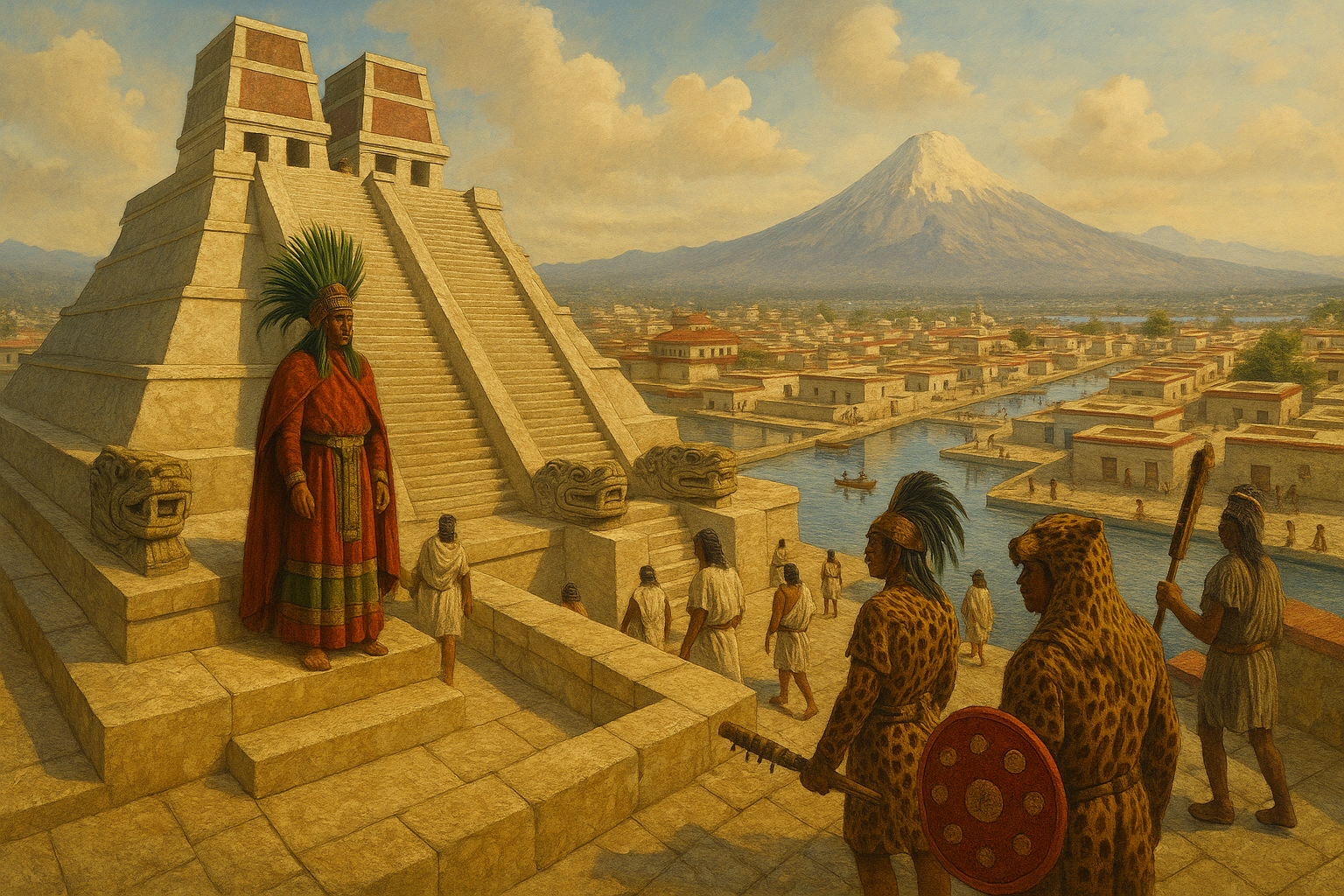
The sun was shining on the temples of Tenochtitlan when, around 1497, a boy of royal blood was born, destined for greatness and tragedy. The son of the emperor Ahuízotl and the noblewoman Tlillalcápantzin, he was given the name Cuauhtémoc, "Descending Eagle". Like all Mexica princes, he was sent to the calmécac, where future leaders learned the discipline of the gods, the power of the word and the art of war.
Already as a young man, around 1515, the prince distinguished himself in battle and rose to the rank of tlacochcálcatl, one of the highest titles in the Mexica army, responsible for the arsenal and for leading forces on campaign. His contemporaries remembered him as a warrior with a steady gaze, with the daring of the jaguar and the flight of the eagle.
In 1519, when Hernán Cortés's men arrived from the sea, Cuauhtémoc was a respected captain. He watched warily as those fair-skinned strangers came with shining armour and horses never seen before. During the reign of his uncle Moctezuma II he remained a military adviser, and under Cuitláhuac, who succeeded Moctezuma after his death in 1520, he was an ally in the defence of the city. But smallpox soon took Cuitláhuac's life in November 1520, leaving the Mexica without a leader in the midst of the storm.
That same year, at barely 25, Cuauhtémoc was raised to huey tlatoani, the last emperor of Tenochtitlan. There was no time for celebrations or lengthy rites: his reign began amid the smoke of war and the cries of hunger.
Over the following months, from May to August 1521, he fiercely led the resistance against the Spanish siege. He ordered the bridges cut, raised barricades on the causeways, organised night attacks from canoes and walked the walls, encouraging his people with the promise that the gods were still watching over them. But the city, weakened by disease and hunger, resisted with less strength each day.
On 13 August 1521, when all was lost, Cuauhtémoc tried to escape in a canoe. He was captured and brought before Cortés. It is said that, upright and calm, he spoke in a clear voice:
"I have done what I was bound to do as a warrior. Take this knife and take my life, for there is nothing more to surrender."
Cortés spared him then, but kept him prisoner, taking him along as a trophy of conquest. In 1525, during the expedition to Honduras, he was accused of conspiracy and executed at Itzamkanac, in Tabasco. He died at just 28, far from the temples that had seen him born.
The memory of Cuauhtémoc
His death was not oblivion but a seed. In independent Mexico, Cuauhtémoc was remembered as the hero who resisted to the end, a symbol of dignity and courage. His figure holds a central place in the national imagination: in the nineteenth century his memory was honoured with monuments such as the one on Paseo de la Reforma in Mexico City (1887). Today his name is found on streets, municipalities and schools, and even on one of the busiest stations of the capital's metro.
Compared with Moctezuma II (1466–1520), remembered for his ambivalence towards the Spaniards and his tragic end, Cuauhtémoc embodies the pride of the people. Moctezuma went down in history as the emperor of uncertainty; Cuauhtémoc, by contrast, as the emperor of resistance. The first is a symbol of downfall, the second of dignity.
And so the Descending Eagle did not die on the gallows: he lives on in the memory of Mexico, the eternally young warrior who chose struggle over submission.