1466–1520: Moctezuma II

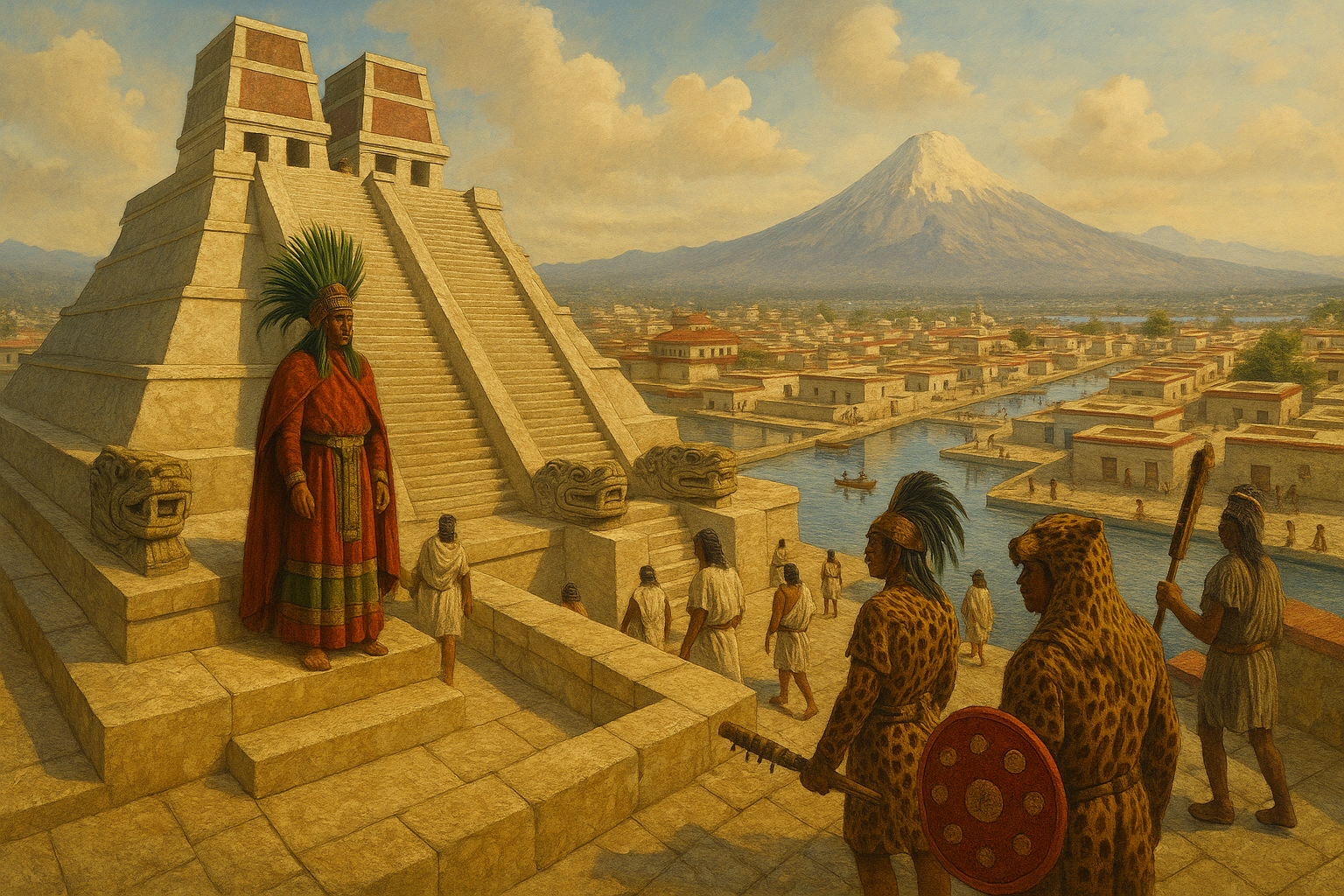
In the heart of Tenochtitlan, surrounded by canals and causeways that seemed to float on the lake, a boy destined for greatness was born around 1466. He was the son of Axayácatl, one of the most powerful tlatoanis to have expanded the Mexica domains, and from an early age he was called Motecuhzoma Xocoyotzin: "The stern lord who grows angry like a lord", the young Moctezuma.
His childhood was spent within the walls of the calmécac, where the children of the nobility were educated in the arts of war and the secrets of religion. There he learned to read the codices, to sing the sacred hymns and to wield the macuahuitl with precision. Reserved and serious by nature, he stood out for his discipline and for a deep religiosity that would mark him forever.
In time, Moctezuma became a feared warrior and a respected priest. He came to the throne in 1502, when his uncle Ahuízotl died. He was little more than thirty when the Mexica nobles chose him as the ninth tlatoani. The young emperor, of majestic bearing and piercing gaze, was received with acclaim, for on his shoulders rested the task of guiding the empire at its height.
An expanding empire
Under his reign, the armies marched south and east. The peoples of the Huasteca, of Oaxaca and of the Maya lands felt the weight of Mexica power. Tribute of cacao, jade, cotton and gold arrived in Tenochtitlan every year, making the city shine as the most brilliant jewel of Anáhuac.
But Moctezuma was not only a conqueror: he was also a reformer. He widened still further the distance between nobles and commoners, demanding strict reverence and establishing a protocol under which no one could look at him directly without his permission. The tlatoani was no longer a man but a living embodiment of the divine.
From around 1517, disturbing rumours began to arrive. Giant vessels had been seen off the Gulf coast, like floating mountains, carrying bearded white-skinned men with weapons that spat fire. Moctezuma listened to the reports with a frown, while comets appeared in the sky and temples burned for no apparent reason. The priests spoke of omens: was the god Quetzalcóatl returning from the east, as the old traditions foretold?
The tlatoani sank into sleepless nights, consulting codices and auguries. His prudent nature mingled with religious fear, and so was born the uncertainty that would mark the rest of his life.
The meeting with Cortés
In November 1519, after months of marches, battles and alliances, Hernán Cortés and his men reached Tenochtitlan. Moctezuma came out to receive them on the great causeway, surrounded by nobles and flower-bearers. The air was solemn, and the silence of the crowd seemed to hold the world's breath. The emperor, dressed in cotton cloaks embroidered with precious feathers, placed a necklace of jade and gold around the Spanish captain's neck. His words were of welcome and respect, charged with that ambivalence that mixed diplomatic courtesy with divine foreboding.
But the apparent friendship soon turned into imprisonment: Cortés, distrustful, kept him in his own palace as a hostage, ruling through him. Moctezuma, who had been master of millions of lives, became a shadow under the watch of the foreigners.

The final tragedy
In 1520, during the festival of Tóxcatl, the Spaniards carried out the massacre at the Templo Mayor, killing dancers and priests. The city burned with fury. Tenochtitlan rose against the invaders, and Moctezuma was forced to speak from a rooftop to calm his people.
The enraged crowd would not listen: stones and arrows rained down on him. Gravely wounded, the tlatoani fell. Some said he died at the hands of his own people; others that it was the Spaniards themselves who killed him to prevent his release.
It was June 1520. Shortly afterwards, the Noche Triste forced the Spaniards to flee the city, and with Moctezuma died not only a man but the stability of the Mexica empire.
Memory and legacy
Today Moctezuma II is remembered with mixed feelings: for some he was a weak ruler who let the conquistadors in; for others, a ruler caught at an impossible crossroads, a victim of the gods, of his faith and of history.
In the reflection of the waters of Lake Texcoco, his voice still seems to be heard, asking whether what he saw in those men from the east was destiny, deception or the inevitable fulfilment of the ancient omens.