
1518–1521: The Conquest of the Mexica Empire
The preparation of the fleet
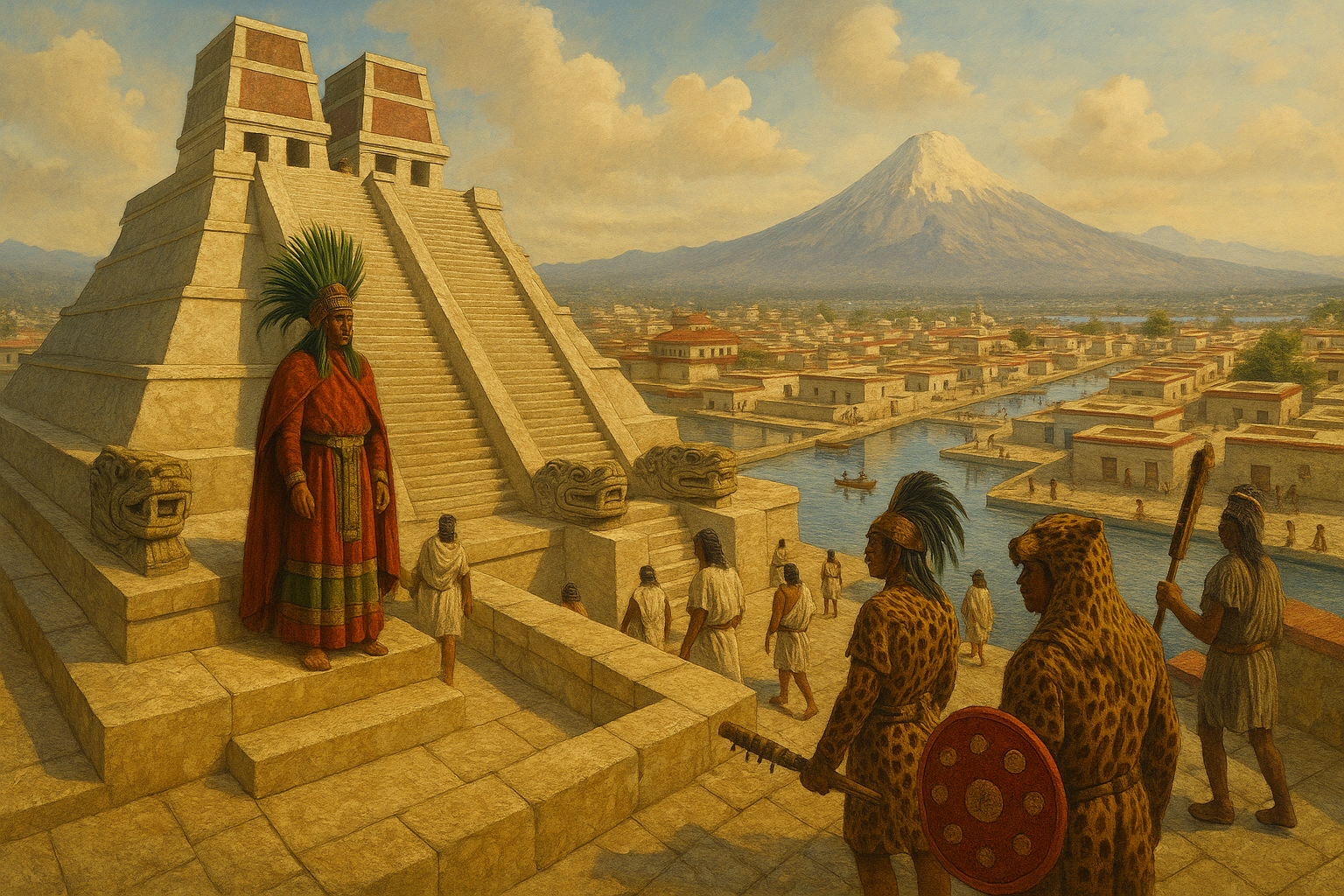
In the ports of Cuba, towards the end of 1518, the air was thick with rumours. Two expeditions had opened the door to an unknown world: that of Francisco Hernández de Córdoba, which had reached the coasts of Yucatán in 1517, and that of Juan de Grijalva, which a year later skirted the beaches of Campeche and pressed on to the lands that would later become Veracruz. Both returned battered by indigenous resistance, but laden with astonishing tales: cities of white stone, temples rising like towers and, above all, signs of gold. The news spread like wildfire among the men of the island.
It was then that the governor, Diego Velázquez de Cuéllar, eager for glory and riches, decided to send a third expedition. He chose Hernán Cortés, an Extremaduran hidalgo who had shown his shrewdness in Cuba as a notary, encomendero and man of business. No one yet suspected that this choice would end up setting the governor against his own captain.
On receiving the appointment, Cortés threw himself into the preparations with feverish zeal. In Santiago de Cuba and the neighbouring ports he began gathering men and supplies. He travelled the island promising gold and honours; he mortgaged estates, took out loans and staked everything he had. He wanted the enterprise to be so large that no one else could dispute his command.
Little by little the fleet grew:
- Eleven ships, some light, others of deeper draught, reinforced and well supplied.
- More than five hundred men: sailors, crossbowmen, arquebusiers, swordsmen and adventurers with no fortune but their sword.
- Sixteen horses, which amazed the islanders as they were loaded onto the decks: costly animals, hard to transport, but which Cortés considered essential.
- Bronze cannon, falconets and lighter artillery pieces, carefully lashed down with ropes and planks.
- Barrels of gunpowder, iron and Castilian steel, along with goods for barter: glass beads, mirrors, coloured cloth and hawk bells, with which they hoped to dazzle the peoples of the mainland.
- Casks of water, ship's biscuit, oil and wine for the crossing; live pigs and hens to provide fresh meat.
On the beaches the spectacle never stopped: carpenters and caulkers hammering at the timber, sailors coiling rigging, soldiers fitting on breastplates rusted by the humid climate. The bustle mingled with anxiety: some saw the venture as a chance to escape poverty on the island; others, as an opportunity to emulate the heroes of medieval epics.
But as the preparations took shape, Velázquez began to grow suspicious. He saw that Cortés was acting with too much independence, recruiting more men than planned and making decisions without consulting him. He suspected, rightly, that this hidalgo from Medellín had no intention of merely trading, but aspired to conquer and to rule.
On the night before the departure, the governor tried to stop him. A messenger arrived with orders to strip Cortés of his command. But the captain was ready for him: he quickly gathered his men, boarded the flagship and ordered the anchors weighed. The eleven sails unfurled in the dawn wind, and the fleet vanished into the half-light of the horizon before Velázquez could act.
Behind lay Cuba, with its furious and betrayed governor; ahead, a continent full of unknowns. Cortés, standing on deck, watched the coast recede and smiled calmly. He knew he had broken his chains and now served no lord but his own ambition and, in his words, the king. The sea carried him towards those lands of temples, markets and armies that Grijalva had described. What had begun as a voyage of exploration had become, that very night, the start of the conquest of an empire.
Villa Rica de la Vera Cruz
Cortés's eleven ships sailed the Caribbean for weeks, until one morning in April 1519 the horizon turned a deep green. It was the coast of a vast land covered in mountains and forests. The humid air carried new and unfamiliar scents, and the men, weary of the voyage, breathed with joy. They had reached the heart of what Grijalva had sighted a year earlier: Anáhuac.
The ships anchored near a wide beach, close to what is now the port of Veracruz. Mexica envoys sent by Moctezuma II came there, eager to find out who these strangers were who arrived in suits of iron, with strange animals and firearms. The messengers brought gifts: food, richly embroidered cloth and, above all, gold objects that gleamed in the sun. Cortés received them courteously, but inwardly he confirmed what he already suspected: this land was full of riches and ruled by a central power.
The Mexica advised the Spaniards to return to their ships and go on their way. Cortés, however, read the gesture as a sign of weakness. Shrewdly, he began to forge alliances with the Totonac peoples of the region, who were subject to Mexica tribute and resented their rule.
Meanwhile, huts, storehouses and a small makeshift hamlet began to rise on the beaches. Cortés realised he had to take a decisive step: to found a Spanish town. So, on the pretext of securing the Crown's presence, he gathered his men and, in a solemn ceremony, proclaimed the founding of the Villa Rica de la Vera Cruz.
- "Villa Rica" (Rich Town) for the abundance of gold that the first contacts revealed.
- "Vera Cruz" (True Cross) because it had been founded during the Easter festivities, in Holy Week.
Mayors and councillors were chosen, bringing to life the first town council on the mainland of New Spain. It was a calculated move: through that council, Cortés no longer answered to Velázquez, the governor of Cuba, but directly to King Charles I. With a clever legal manoeuvre, he had broken his ties with his former superior and legitimised his enterprise.
On those beaches, anxiety and hope mingled. The soldiers, who until then had seen the expedition as an uncertain adventure, began to feel that this settlement was the beginning of something greater. There, facing the sea, the first Spanish nucleus in Mexico was born, the starting point from which the march inland would be organised.
Before long, Cortés, fearing desertion and the return of some men to Cuba, took a drastic decision: to scuttle the ships. With that, he cut off any possibility of retreat. The only way left was forward, inland, towards the great cities the Mexica envoys spoke of.
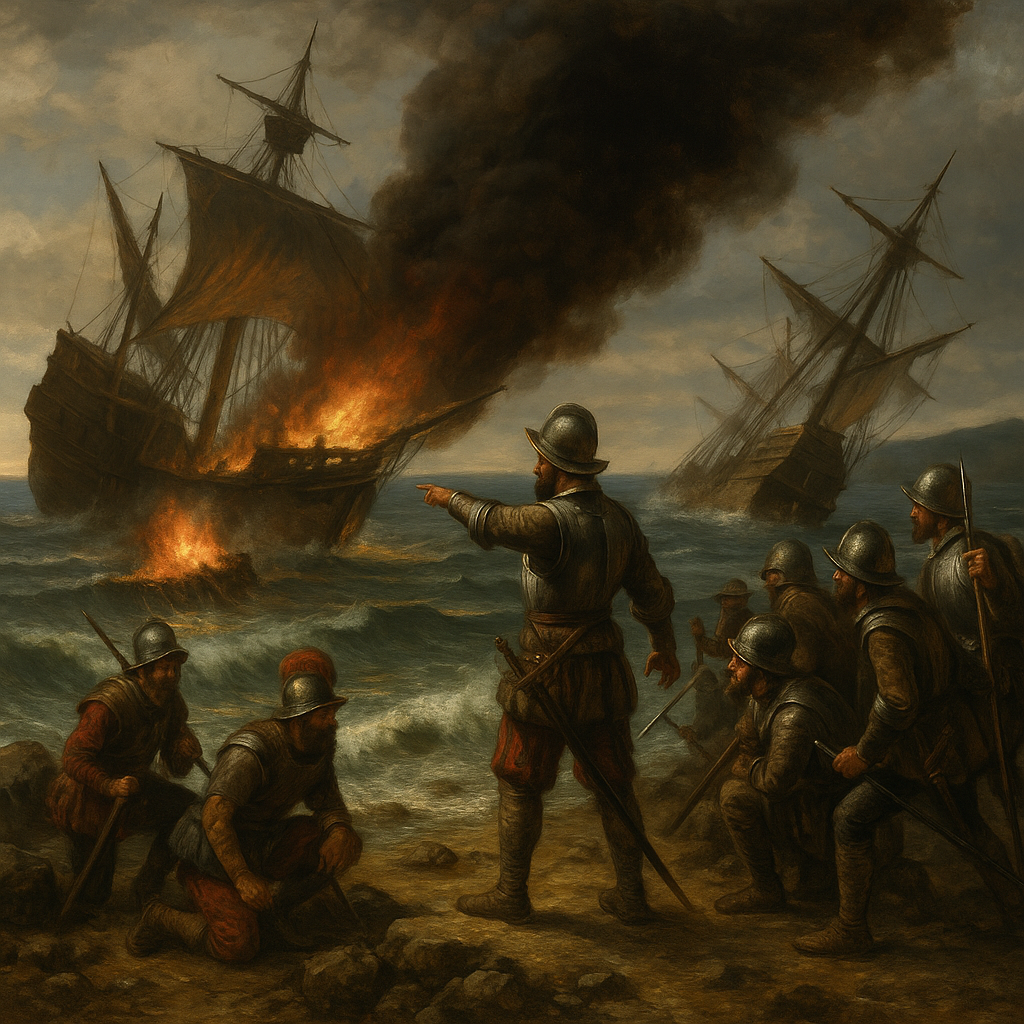
The men watched the sails burn and the hulls break open beneath the salt water. They knew then that there was no turning back: before them lay an unknown continent, and behind them, the immense ocean. The die was cast at Veracruz.
Building alliances
The echo of axes and the smoke of the scuttled ships still hung in the air of Veracruz when Cortés decided to head inland. He had sealed his men's fate: there was no going back. Now the only option was to advance towards the heart of the vast empire the Mexica messengers had spoken of.
The road was harsh and full of uncertainty. Thick forests, high mountains and stony paths tested the endurance of soldiers and horses. But each day also brought encounters with new peoples. The Totonacs, tired of the tribute they had to pay the Mexica emperor, did not hesitate to support the Spaniards: they offered food, porters and valuable information about the politics of the highlands. Cortés understood that it was not gunpowder alone that would open the way for his expedition, but the resentment built up against Tenochtitlan.
Soon a formidable obstacle appeared before them: the Tlaxcalan confederation, sworn enemies of the Mexica. Cortés hoped to win them as allies, but the Tlaxcalans received him with spears and clubs. For weeks the Spaniards and their Totonac allies fought hard battles on the plains, where the indigenous hosts hurled themselves in endless waves against the horses and artillery.
The battles seemed endless, until Tlaxcalan resistance broke. Impressed by the courage of the foreigners and aware that they could be a powerful weapon against their ancestral enemies, the lords of Tlaxcala finally offered peace. Cortés entered the city as a guest, and there, amid banquets and rituals, the most decisive alliance of the entire conquest was sealed. From that moment the Tlaxcalans became not only allies but brothers in arms, contributing thousands of warriors to the Castilian ranks.
With that backing, Cortés marched on Cholula, a city of tall temples and great religious importance in the shadow of the Popocatépetl volcano. He was received there with ceremony, but rumours soon arose: the Mexica were planning to ambush them. Cortés acted swiftly and harshly. He summoned the city's leading men to the ceremonial courtyard and, suddenly, ordered an attack. The Spanish and Tlaxcalan troops unleashed a massacre that remained etched in the memory of Mesoamerica as the "Cholula massacre".
That bloodshed, cruel as it was, consolidated Cortés's image as a relentless leader, able to punish treachery and reward loyalty. For the subject peoples, he now represented a real alternative to Moctezuma's power; for his men, a leader who knew how to turn weakness into strength through alliance and fear.
When the columns of smoke over Cholula cleared, the road to Tenochtitlan lay open. What had begun as an expedition of strangers had become a coalition of indigenous peoples and Spaniards, led by a captain who had gone from adventurer to undisputed commander.
The meeting with Moctezuma
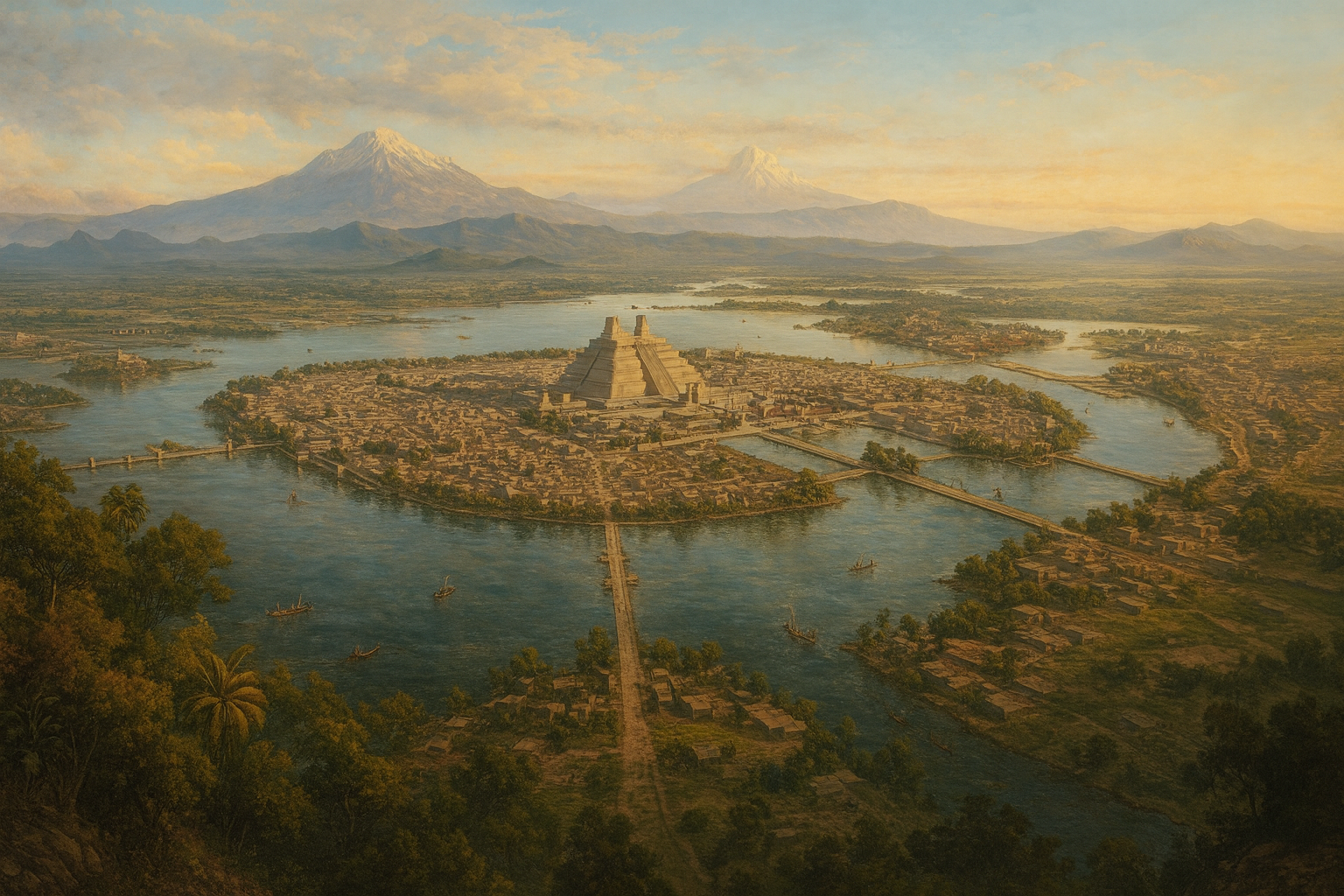
On 8 November 1519, after months of battles, alliances and betrayals, the column of Cortés and his Tlaxcalan allies came down from the mountains and beheld the splendour of the Valley of Mexico. Before their eyes stretched an unrivalled landscape: the lake shining in the sun, surrounded by snow-capped volcanoes, and in the middle of the waters, rising like a mirage, the city of Mexico-Tenochtitlan.
The Spaniards were awestruck. They had never seen anything like it: stone causeways crossing the lake like giant arms, canals busy with canoes, temples rising into the sky, markets overflowing with goods and crowds filling the squares. "It was like seeing the cities of Venice and Seville together," some chroniclers would later write.
Moctezuma II, tlatoani of the Mexica, had closely followed every step of the foreigners. He was unsure whether these men were divine envoys or mere invaders, but he understood that he had to deal with them through diplomacy. Dressed in cotton cloaks embroidered with precious feathers, he came out to receive Cortés on the Iztapalapa causeway, accompanied by nobles and priests.
The meeting was solemn and full of symbolism. When Moctezuma tried to touch the ground as a sign of reverence, Cortés, breaking Mexica protocol, stopped him and embraced him as an equal. The gesture bewildered everyone: the Mexica saw their lord as a representative of the gods, untouchable by mortals.
The tlatoani led the newcomers to the heart of the city, to the majestic palace of Axayácatl, where they were lodged. Cortés and his men walked in amazement among the temples of the sacred precinct, the colossal sculptures and the altars where incense still smoked. The murmur of the people, curious and fearful, accompanied the procession.
In the following days, Moctezuma showered the Spaniards with gifts: gold necklaces, fine featherwork, jade and cacao. But at the same time the Mexica watched every move of the foreigners, aware that the presence of so many Tlaxcalan warriors in the city was a threat. Cortés, skilful and calculating, understood that as long as Moctezuma remained free, his own position would be fragile. And so, through cunning and pressure, he achieved the unthinkable: the emperor agreed to stay in Spanish custody. To the Castilian chroniclers it was a gesture of submission; to many Mexica, an ominous sign that the gods had withdrawn their favour.
The city went on with its usual life—the markets of Tlatelolco overflowed with produce, priests performed sacrifices at the Templo Mayor, the causeways filled with travellers—but beneath that normality hung an invisible tension. In the middle of the lake, the jewel of the Empire had opened its doors to the foreigners… and in doing so had sealed the beginning of its tragedy.
The first months in Tenochtitlan passed in a tense calm. Cortés and his men lived as both guests and guards inside the palace of Axayácatl, while Moctezuma II remained in custody, though he still kept part of his imperial dignity. The Mexica people, however, looked with growing distrust at the foreigners and their Tlaxcalan allies, who roamed the city as if they owned it.
La Noche Triste (the Night of Sorrows)
In the spring of 1520, news upset the whole balance: an expedition sent by Governor Diego Velázquez, commanded by Pánfilo de Narváez, had arrived on the coast with orders to arrest Cortés for acting without authorisation. Cortés left Pedro de Alvarado in command in Tenochtitlan and marched off with part of his forces. Cunning and bold, he defeated Narváez at Cempoala and persuaded his men to join his cause, doubling his army.
But in his absence, tragedy struck. During the festival of Tóxcatl, in honour of Huitzilopochtli, the Mexica gathered in the sacred precinct. Alvarado, fearing an uprising or wishing to intimidate them, ordered a surprise attack on the unarmed nobles and priests who were dancing. Blood flowed at the Templo Mayor: the sacred drums fell suddenly silent and the people rose up in fury.
When Cortés returned to the city, he found an inferno. The streets had become battlefields. The Spaniards were besieged in their palace, and the Mexica, now led by Cuitláhuac, Moctezuma's successor, swore to wipe them out. Moctezuma tried to calm his people but was driven back with stones and arrows; shortly afterwards he died, in unclear circumstances, a prisoner in his own house.
The siege became unbearable: food was scarce, the bridges had been cut and hostility grew by the hour. Cortés understood that he had to flee. On the night of 30 June 1520, in the rain, the Spaniards and their allies tried to escape along the Tacuba causeway, laden with gold and treasure. But they were discovered.
The lake erupted with cries, arrows and spears. Mexica canoes attacked relentlessly, while warriors on foot defended the narrow bridges. Many soldiers, weighed down by plundered gold, fell into the water and drowned. Horses and men sank among the broken planks. It was the Noche Triste. Only part of the force managed to fight its way through to dry land.
The survivors wept beneath an ancient ahuehuete tree on the outskirts of the city. They had lost men, weapons and almost all the booty. But from that defeat a new determination was also born: with the renewed support of Tlaxcala and other cities hostile to the Mexica, Cortés swore to return and conquer Tenochtitlan, whatever the cost.

The fall of Tenochtitlan
After the bitter defeat of the Noche Triste, Hernán Cortés did not give up. In Tlaxcala he reorganised his forces, tended his wounded and renewed the alliance with the peoples hostile to the Mexica. There the final strategy took shape: there would be no frontal assault, but a systematic siege that would cut Tenochtitlan off from its resources and leave it no respite.
With the help of carpenters and sailors, Cortés ordered thirteen brigantines to be built in Texcoco: light vessels armed with cannon, which would be dismantled, carried overland and launched on the lake. These Spanish ships, together with hundreds of allied canoes, would dominate the waters, neutralising the Mexica fleet and isolating the city.
In May 1521 the siege began. Three great columns, each with thousands of Tlaxcalan, Totonac and other allied warriors, advanced along the Tacuba, Iztapalapa and Tepeyac causeways. Day after day, house after house, the fighting intensified. The Mexica, now led by the young tlatoani Cuauhtémoc, put up fierce resistance.
The once splendid city became a field of ruins. The canals filled with bodies, the temples burned, and hunger and disease (above all smallpox, brought by the Europeans) decimated the population. Even so, the Mexica fought desperately, defending every bridge and every square, aware that this was the final defence of their world.
For three months the fighting did not let up. Finally, on 13 August 1521, Cuauhtémoc tried to escape in a canoe but was captured on the lake. Brought before Cortés, he spoke the words that marked the end of the empire: "Lord Malinche, I have done what I was bound to do in defence of my city and my people. And since I now come before you by force and as a prisoner, take that dagger you wear at your belt and kill me with it."
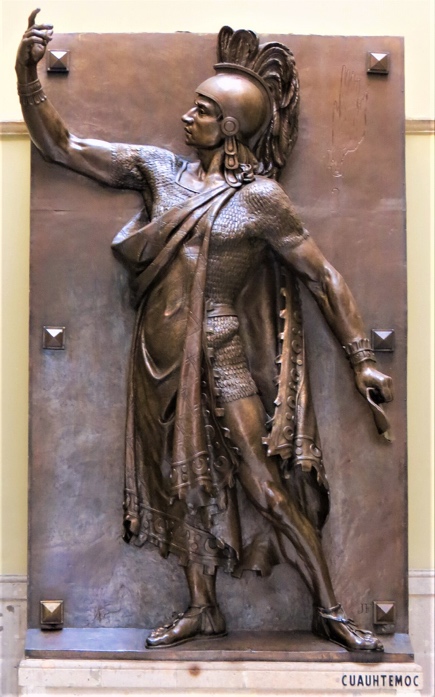
Cortés, however, kept him prisoner. With his capture, the great city of Mexico-Tenochtitlan fell. The causeways, once teeming with life, were now smoking ruins. On the ruins of that empire would rise Mexico City, capital of the new viceroyalty of New Spain.


