1500–1526: Malintzin

The elders say that Malinalli Tenépal was born around the year 1500, on the green banks of the Coatzacoalcos, where the mist embraces the hills and the rivers melt into the jungle. Her name, "Malinalli", evoked twisted grass, a symbol of changing fate.
The daughter of a local cacique, in her early years she knew the dignity of the indigenous nobility. She ran free in the courtyard of her home, learned the ceremonial words of Nahuatl and listened, fascinated, to the priests who told of the greatness of Tenochtitlan.
But fortune is fickle: her father died, her mother remarried, and Malinalli was pushed aside in favour of the new son. One dark night she was handed over to merchants. The girl's heart broke, and with it snapped the thread of the life she had known.
Taken to distant lands, Malinalli came to the domains of the Chontal people of Tabasco. There, lost in a strange world, she learned to survive. With patience and a sharp ear, she made the Maya language her own. What had been loss became a gift: she spoke two languages fluently, could move between worlds and hear what others could not understand.
She was a slave, yes, but she never lost the dignified gaze of someone who knows that words are power.
The arrival of the Spaniards
Destiny caught up with her in 1519. The bearded men clad in iron arrived from the sea, led by Hernán Cortés. The Chontal were defeated at the battle of Centla, and as tribute they handed over twenty young slave women. Malinalli was among them.
Baptised with the name Marina, she began to interpret. At first she worked alongside Jerónimo de Aguilar, a Spanish castaway who spoke Maya: she translated from Nahuatl into Maya, and Aguilar from Maya into Spanish. But she soon learned Castilian, and her voice became indispensable.
Cortés's tongue
She was soon called, with respect, Malintzin—"noble Marina". At every meeting, at every council, it was her voice that made it possible for the two worlds to understand each other. The Totonacs, the Tlaxcalans, the Mexica: all heard Cortés's words in Nahuatl through her.
But Malinche was not only an interpreter. She observed, advised and warned. She alerted Cortés to conspiracies and showed him the wounds of Mexica rule. Thanks to her intelligence, the Extremaduran was able to forge alliances with resentful peoples such as the Tlaxcalans, sworn enemies of Moctezuma.
The codices always show her beside Cortés, never behind him. She was the human bridge between the Old World and the New.

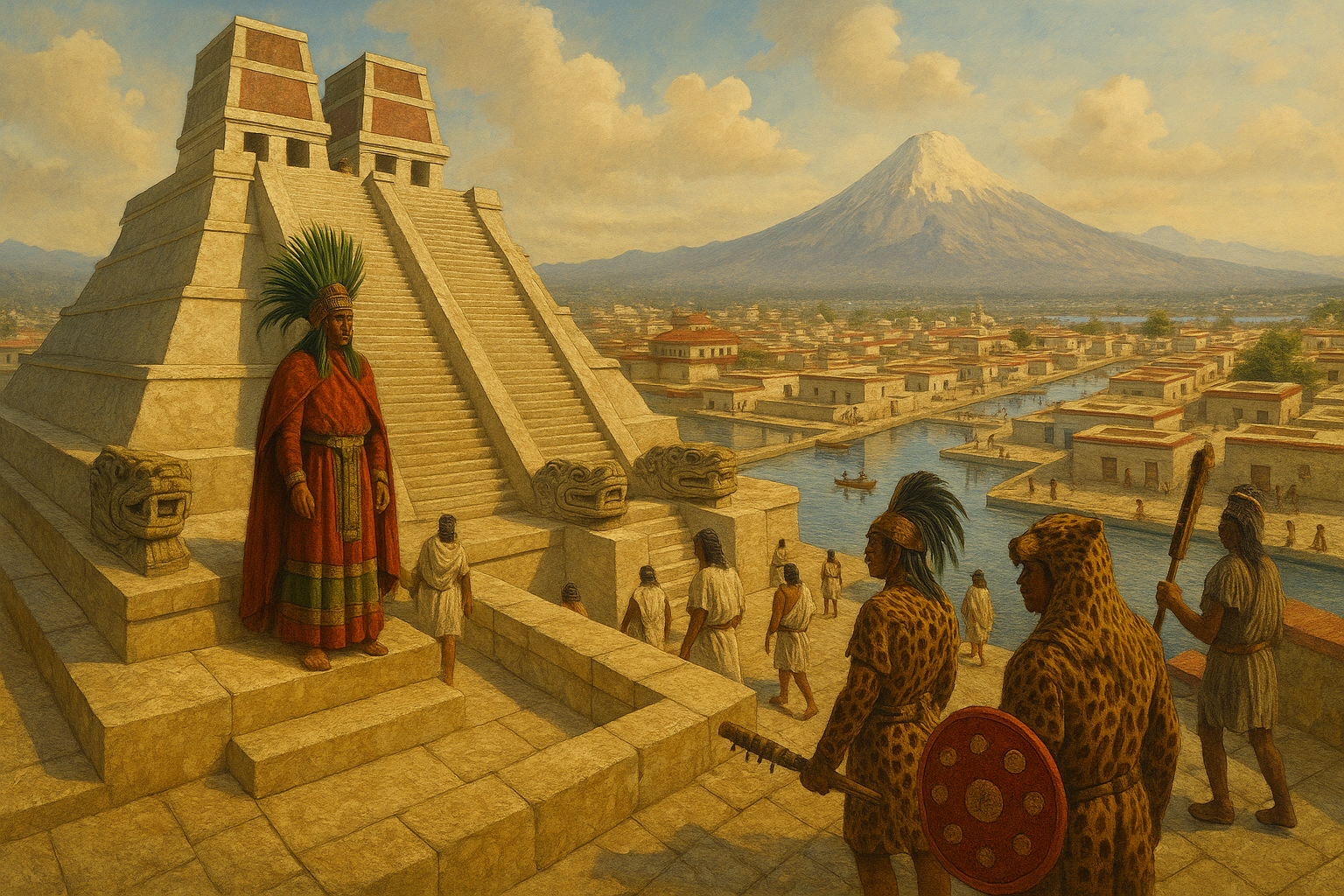
On 8 November 1519, the Spanish party entered Tenochtitlan. The lake reflected the temples like sacred mirrors, and the causeways teemed with people. When Moctezuma spoke, it was Malintzin who translated his words for Cortés, and the conqueror's reply for the emperor. In that moment she was the thread joining two irreconcilable universes.
The Mexica looked at her with wonder and suspicion: was she the foreigners' accomplice or an envoy of the gods?
History turned violent. Malinche witnessed the massacre at the Templo Mayor; the Noche Triste, when the Spaniards fled in the rain and bodies covered the canals; and finally the siege of Tenochtitlan (1521), where hunger and disease brought the great city to its knees.
Amid gunpowder and weeping, her voice never ceased to ring out. She was Cortés's tongue, but also the woman who translated pleas, promises and betrayals.
Love and descendants
From her union with Cortés a son was born in 1522, Martín Cortés, one of the first mestizos of New Spain. That child, of Spanish and indigenous blood, symbolised the beginning of a new identity, a blend of cultures.
Later, Cortés married her to the captain Juan Jaramillo, with whom she had a daughter, María.
In 1526 she accompanied Cortés on the expedition to Honduras. After that campaign the records grow dark. She died young, probably a victim of smallpox or of complications in childbirth. She was no more than twenty-five. Her body had no marked grave, and her memory was shrouded in silence.

But her figure did not disappear: the codices and chronicles kept showing her at Cortés's side, inseparable.
An enduring legacy
After her death, her name was contested:
- Traitor, for those who blamed her for the indigenous defeat.
- Victim, for those who remembered that she was sold into slavery as a child.
- Symbolic mother of Mexico, for having given birth to one of the first mestizos.
- Mediator and strategist, for those who recognise her intelligence and decisive role.
In Mexico her name gave rise to the term malinchismo, meaning a preference for all things foreign. But today many see her as an extraordinary woman who, amid the clash of worlds, used words as her only weapon and left a mark that cannot be erased.
Thus the story of Malintzin / La Malinche / Doña Marina is not only that of a woman trapped between two worlds, but of one who fused two civilisations in her own voice.