
Columbus's First Voyage (1492)

The first voyage
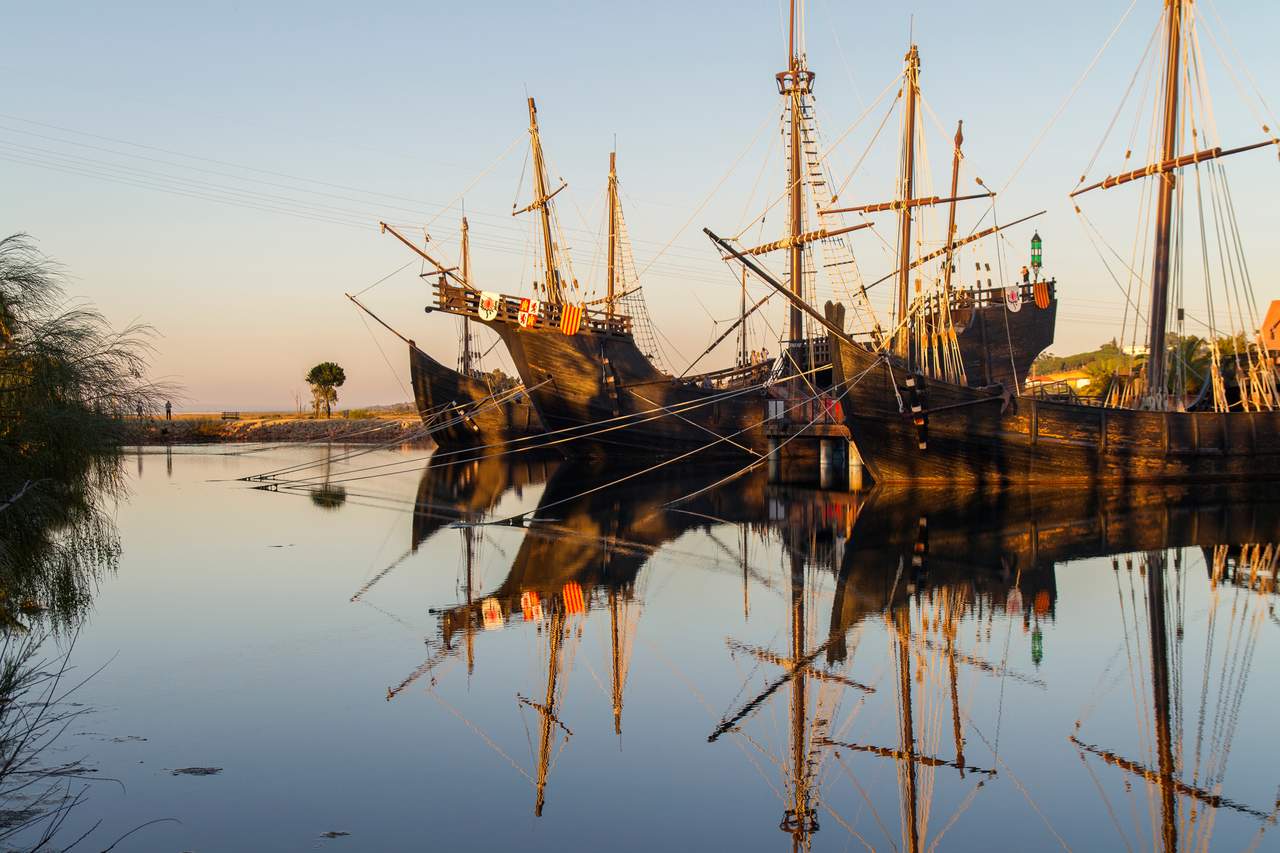
On 3 August 1492, a small fleet of three ships—the Niña, the Pinta and the Santa María—set sail from the port of Palos, in Huelva. Their crews, men hardened by life at sea, left with a clear goal: to find a route to the Indies by sailing west. None of them imagined they were about to discover an entirely new world.
The stop in the Canary Islands
After a few days at sea, the Pinta's rudder suffered irreparable damage. This forced the expedition to stop in the Canary Islands, where it remained until 6 September. On La Gomera, Columbus visited the influential governor Beatriz de Bobadilla, while carpenters worked tirelessly to build a new rudder. The Pinta's triangular sails were also replaced with square ones, making her the fastest caravel in the fleet.
During that month, the crew took on provisions and repaired the ships. Finally, on 6 September, they left the islands behind and headed out into the vast Atlantic Ocean.
The endless crossing
The days stretched out on the boundless sea, and the men's spirits began to crumble. The ocean, endless and desolate, seemed to lead nowhere. Murmurs of discontent grew among the crew, who began to question Columbus's promises. Some called him mad; others urged turning back before it was too late.
Yet nature offered small signs that restored some hope. They entered the enigmatic Sargasso Sea, where dense green and brown seaweed floated on the surface, a phenomenon the sailors associated with the nearness of land. They also sighted flocks of birds flying close to the ships, an unmistakable sign that the coast was not far away.
"Land ho!"
In the early hours of 12 October 1492, a cry broke the calm of the ocean. From the top of the Pinta, the lookout Rodrigo de Triana sighted land and gave the signal with a cannon shot. The jubilant crew rushed on deck to gaze at the green foliage of an unknown island. Columbus, convinced he had reached the coast of Asia, landed on the island the natives called Guanahaní and renamed it San Salvador, attributing the success of his enterprise to divine providence.
On coming ashore, they were greeted by the island's inhabitants, who, naked and with their bodies painted in bright colours, watched them with a mixture of astonishment and reverence. The natives offered exotic fruits, tame birds and gold ornaments. In return, Columbus and his crew gave them small gifts: glass necklaces, bells and caps. Communication was limited, but gestures and smiles served to strengthen this unexpected encounter between two worlds.
More islands, a shipwreck and the return
After exploring Guanahaní, the expedition continued on to other Caribbean islands. On 28 October they reached an island Columbus named La Juana (present-day Cuba), and on 6 December they arrived at La Española (Hispaniola, present-day Santo Domingo). It was here that the Santa María, the flagship, ran aground on a sandbank on 25 December. Timber from the wreck was used to build Fort La Navidad, the first European settlement in the Americas, where forty men were left under the command of Diego de Arana.
With only two caravels left, the Niña and the Pinta, the expedition set off for home. On 6 January 1493 the ships were reunited after a storm had separated them. They finally reached the port of Palos on 15 March 1493, carrying native fruits, exotic animals, gold and a small group of indigenous people as proof of the expedition's success.
The impact of the discovery
Columbus was received in Barcelona by the Catholic Monarchs on 3 April 1493. He proudly presented what he believed to be the coasts of Asia, unaware that he had discovered an entirely new continent. Although the real impact of the voyage would not be understood until years later, that first voyage marked the beginning of a new era in human history, joining two worlds that until then had remained apart.
Share
Relacionados
-
 Christopher Columbus's Voyages
The Discovery (1492)
-
 Christopher Columbus's Voyages
Logbook of the First Voyage
-
 Christopher Columbus's Voyages
Columbus's Second Voyage (1493-1496)
-
 Christopher Columbus's Voyages
Columbus's Third Voyage (1498-1500)
-
 Christopher Columbus's Voyages
Columbus's Fourth Voyage (1502-1504)