
Columbus's Third Voyage (1498-1500)

The third voyage – A new continent
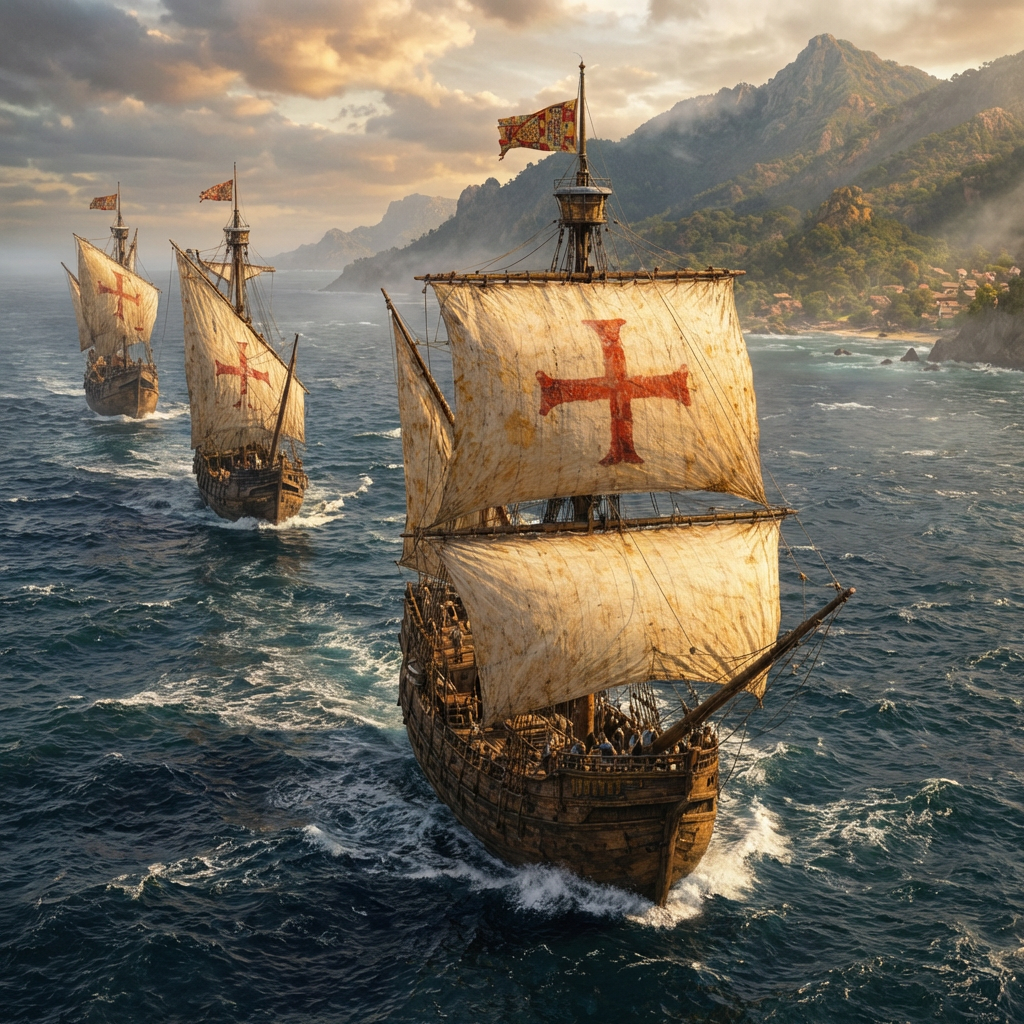
Christopher Columbus's third voyage began on 30 May 1498, when the Admiral set sail from the port of Sanlúcar de Barrameda with six ships and a clear purpose: to explore new lands south of the Antilles and confirm theories about the existence of an unknown continent on the other side of the Atlantic. Suffering from arthritis and eye problems, Columbus faced the voyage with a mixture of hope and pressure, aware of the Catholic Monarchs' expectations.
After a brief stop in the Canary Islands, Columbus divided the fleet. Three ships were sent to Hispaniola with supplies for the settlers and for his brother Bartholomew. With the other three, the Admiral headed south-west into less familiar waters. The crossing was challenging, with a stifling calm that held the fleet still for a week in tropical latitudes. However, on 31 July 1498, the young ship's boy Alonso Pérez sighted land from the mainmast. Before them rose an island with three peaks, which Columbus named Trinidad in honour of the Holy Trinity.
The discovery was almost miraculous, as the fleet was running out of fresh water. Sailing along the south coast of Trinidad, they reached Punta de Playa, where they were able to take on water from a nearby river. Without knowing it, Columbus first set eyes on the American mainland on 1 August 1498. Facing the mouth of the Orinoco River, in present-day Venezuela, he believed he had found yet another island, which he called Isla Santa.
Intrigued by the great flow of the Orinoco and the vast stretches of land, Columbus began to theorise. In his imagination, those lands might be the edge of the Earthly Paradise, the place described in the Bible as the Garden of Eden. The lush vegetation, the pleasant climate and the abundance of fresh water reinforced this belief.
Exploring the Gulf of Paria was as challenging as it was fascinating. The strong currents and violent tides at the mouths of the gulf led Columbus to name them the Serpent's Mouth and the Dragon's Mouth. Venturing further into the region, the expedition found idyllic beaches and made contact with the natives, who wore gold and pearl ornaments. This finding raised hopes of great riches for the Crown.
On 6 August, Columbus took symbolic possession of the American continent in the region of Paria, although his poor health prevented him from going ashore. His captain, Pedro de Terreros, performed the official act. In the following days they sailed along the west coast of Trinidad, marvelling at the beauty of the landscape and the promise of wealth.
However, Columbus had to return to Hispaniola. On 11 August 1498, after negotiating the turbulent waters of the Dragon's Mouth, the fleet headed north. Despite the wonders discovered, challenges awaited the Admiral on Hispaniola. On his arrival on 20 August he found a critical situation: Francisco Roldán was leading a rebellion against the authority of Bartholomew Columbus, while the settlers voiced their discontent over the hardships and the lack of the promised riches.
The tensions led the Catholic Monarchs to send Francisco de Bobadilla to investigate the accusations against Columbus and his brothers. In 1500 the Admiral was arrested and sent back to Spain in chains, although he later regained his freedom. This unfortunate outcome marked the decline of his prestige, but it does not diminish the importance of the third voyage. The discoveries of Trinidad, Venezuela and the Gulf of Paria broadened the horizons of the known world and laid the foundations for future exploration of the American continent.
Share
Relacionados
-
 Christopher Columbus's Voyages
The Discovery (1492)
-
 Christopher Columbus's Voyages
Columbus's First Voyage (1492)
-
 Christopher Columbus's Voyages
Logbook of the First Voyage
-
 Christopher Columbus's Voyages
Columbus's Second Voyage (1493-1496)
-
 Christopher Columbus's Voyages
Columbus's Fourth Voyage (1502-1504)