
The Discovery (1492)

Historical context
Fifteenth-century Europe watched, with a mixture of astonishment and frustration, as the Silk Road became inaccessible after the fall of Constantinople in 1453, now under Ottoman control. The long confrontation between Islam and Christianity, which had already lasted for centuries, had closed one of the most prosperous routes for European trade. Spices, silks and other Eastern treasures had become unattainable, forcing merchants to seek alternative routes that promised wealth but also great risks.
In that context, the Portuguese explorations in the Indian Ocean were born of this ambition. Portugal had completed its reconquest before Castile and focused its efforts on opening new routes along the coast of Africa and across the Indian Ocean. The Treaty of Alcáçovas, signed on 4 September 1479, granted Portugal exclusive rights to navigate the African coast, allowing it to open the Indian Ocean route.
The western dream and Columbus's first voyage
In 1492, a Genoese navigator, Christopher Columbus, persuaded the Catholic Monarchs to finance his daring enterprise. His goal: to reach Asia by sailing west. Although the Earth was already known to be round, Columbus underestimated its size. Confident, he set out from Palos de la Frontera into the unknown. But instead of the Asian coast, Columbus came upon a new continent, a discovery that not even he would fully understand. For years he believed he had reached the longed-for lands of the East, until in 1513 Vasco Núñez de Balboa sighted the Pacific from the Isthmus of Panama, revealing that America was not an extension of Asia but a continent in its own right.
The great leap to the Pacific
Maps began to change, and with them, the conception of the world. The expedition of Ferdinand Magellan, completed after his death by Juan Sebastián Elcano between 1519 and 1522, was a definitive milestone. Not only was the vast Pacific Ocean crossed, but for the first time the globe was circumnavigated. The true size of the Earth was revealed, and future trade routes could be planned with far greater precision.
The tornaviaje and global connection
The discovery of the "tornaviaje" (the return route across the Pacific) by Andrés de Urdaneta in 1565 was another crucial milestone. This finding, which connected the Philippines with Mexico by taking advantage of Pacific currents and winds, opened the door to transcontinental trade through the Manila Galleon. From exotic Asian spices and silks to American silver, trade routes wove a network connecting three continents: Asia, America and Europe. The oceans became bridges joining worlds, marking the beginning of what centuries later would be called globalisation.
A lasting legacy
The echo of those discoveries resonated not only in the economy but also in cultures and ideas. The world, which had once felt vast and fragmented, began to shrink through a continuous exchange of goods and knowledge. The maritime Silk Road, consolidated by Spain during the sixteenth century, was a testament to human ingenuity and persistence.
From Columbus's dreams to the majesty of the Manila Galleon, the European Renaissance gave birth to a new chapter in history. Thus, the connection between Asia, America and Europe not only defined an era but laid the foundations of the modern world.
Timeline of the main events of 1492
- Conquest of Granada (2 January)
- The Catholic Monarchs, Isabella of Castile and Ferdinand of Aragon, completed the Reconquista with the capture of the Nasrid kingdom of Granada, the last Muslim stronghold on the Iberian Peninsula.
- The last Nasrid king, Boabdil, withdrew to the Alpujarras, ending almost 800 years of Islamic rule.
- This event consolidated the territorial unification of Spain under the Christian faith.
- Alhambra Decree and expulsion of the Jews (31 March)
- The Catholic Monarchs signed the Alhambra Decree, ordering the expulsion of Sephardic Jews who would not convert to Christianity.
- It is estimated that around half of the 70,000 to 100,000 Jews were exiled.
- Many of those expelled settled in the Ottoman Empire, North Africa and other parts of Europe.
- Capitulations of Santa Fe (17 April)
- The Catholic Monarchs signed an agreement with Christopher Columbus setting out the terms of his expedition to the west.
- Christopher Columbus's expedition
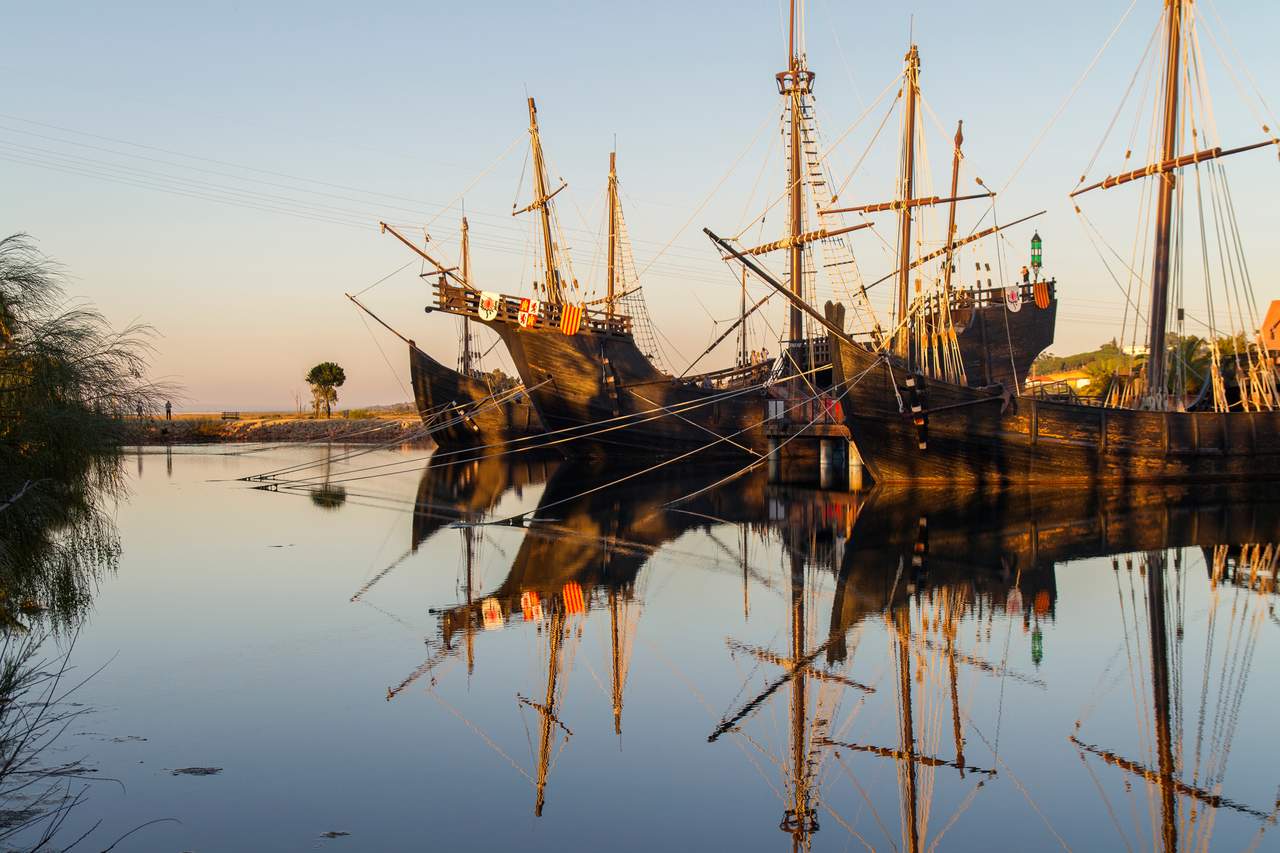
- 3 August: Columbus left the port of Palos de la Frontera with three ships: the Niña, the Pinta and the Santa María.
- 12 October: Columbus and his crew landed on the island of Guanahaní, marking the discovery of America.
- Election of Pope Alexander VI (11 August)
- The Spanish cardinal Rodrigo de Borja was elected pope, taking the name Alexander VI.
Conclusion
The year 1492 marked a turning point in world history:
- In politics, Spain moved towards unification with the conquest of Granada.
- In religion, Christian uniformity was promoted through the expulsion of Jews and Muslims.
- Globally, Columbus's expedition began a new era of exploration and colonisation.
Share
Relacionados
-
 Christopher Columbus's Voyages
Columbus's First Voyage (1492)
-
 Christopher Columbus's Voyages
Logbook of the First Voyage
-
 Christopher Columbus's Voyages
Columbus's Second Voyage (1493-1496)
-
 Christopher Columbus's Voyages
Columbus's Third Voyage (1498-1500)
-
 Christopher Columbus's Voyages
Columbus's Fourth Voyage (1502-1504)