
Christopher Columbus's Four Voyages (1492–1504)

Between 1492 and 1504, Christopher Columbus crossed the Atlantic four times in the service of the Crown of Castile. The first voyage opened the route between Europe and America; the second brought settlers and founded the first town; the third reached the mainland for the first time; the fourth sailed along the coasts of Central America and ended in shipwreck. This guide summarises the four voyages and links to the full article on each one.
The four voyages at a glance
| Voyage | Dates | Port of departure | Fleet | Main discoveries | Outcome |
|---|---|---|---|---|---|
| First | 3 August 1492 – 15 March 1493 | Palos (Huelva) | 3 ships: the Niña, the Pinta and the Santa María | Guanahaní (San Salvador), Cuba and Hispaniola | Wreck of the Santa María and Fort Navidad |
| Second | 25 September 1493 – June 1496 | Cádiz | 17 ships and 1,800 men | Lesser Antilles, Cuba and Jamaica; founding of La Isabela | Fort Navidad destroyed and complaints at Court |
| Third | 30 May 1498 – 1500 | Sanlúcar de Barrameda | 6 ships | Trinidad, the Gulf of Paria and the Orinoco delta: first contact with the mainland | Roldán's revolt; Columbus sent back to Spain in chains |
| Fourth | 9 May 1502 – 7 November 1504 | Cádiz | 4 caravels and 150 men | Coasts of Honduras, Nicaragua, Costa Rica and Veragua | A year shipwrecked on Jamaica |
The first voyage (1492–1493): two worlds meet
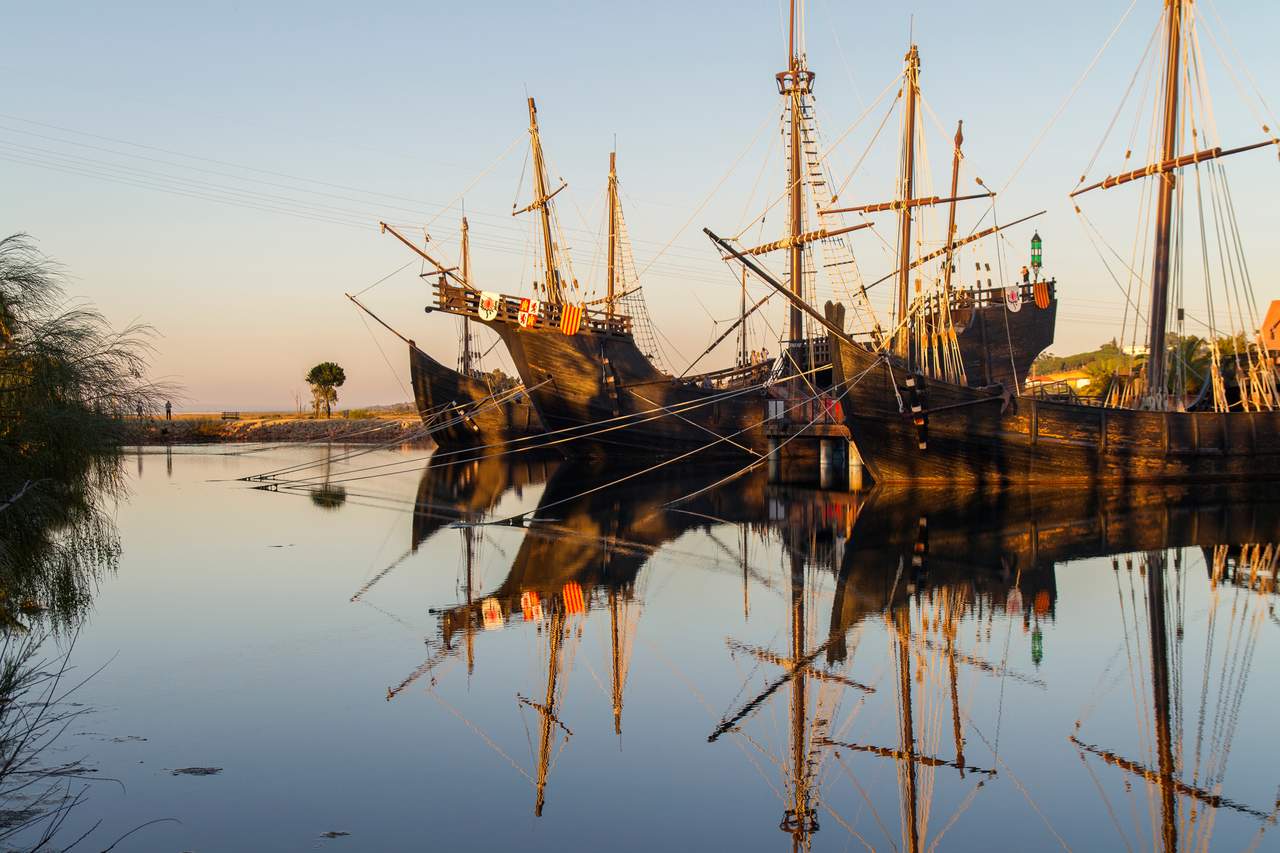
On 3 August 1492, the Niña, the Pinta and the Santa María sailed from the port of Palos. After a stop in the Canary Islands to repair the Pinta's rudder, the fleet headed into the Atlantic on 6 September. After weeks of uncertainty, the lookout Rodrigo de Triana sighted land in the early hours of 12 October 1492: the island of Guanahaní, which Columbus named San Salvador.
The expedition went on to Cuba and Hispaniola, where the Santa María ran aground on 25 December. Its timbers were used to build Fort Navidad, the first European settlement in America. The Niña and the Pinta returned to Palos on 15 March 1493. The captain of the Niña was Vicente Yáñez Pinzón.
Columbus recorded the crossing day by day. His logbook of the first voyage survives in the version of Friar Bartolomé de las Casas. For the background that made the venture possible, see The Discovery (1492).
The second voyage (1493–1496): from exploration to colonisation
On 25 September 1493 a very different fleet left Cádiz: seventeen ships and 1,800 men, with settlers, clergy, seeds and animals. The aim was no longer only to explore but to settle. The expedition was organised by Bishop Juan Rodríguez de Fonseca.
After sailing through the Lesser Antilles, Columbus found Fort Navidad burnt to the ground. Close by he founded La Isabela on 6 January 1494, and from there he explored Cuba and Jamaica. Crops failed, discontent and conflict with the local population grew, and the Crown sent Juan de Aguado to investigate him. Columbus returned to Cádiz in June 1496.
The third voyage (1498–1500): reaching the mainland
On 30 May 1498 Columbus left Sanlúcar de Barrameda with six ships. He sent three straight to Hispaniola and took the other three south-west. On 31 July he sighted an island with three peaks, which he named Trinidad.
On 1 August 1498, off the mouth of the Orinoco in present-day Venezuela, Columbus saw the American mainland for the first time, though he took it for another island. He explored the Gulf of Paria, where the local people wore gold and pearl ornaments. Back on Hispaniola he faced Francisco Roldán's revolt. The Monarchs sent Francisco de Bobadilla, who in 1500 arrested him and shipped him back to Spain in chains.
The fourth voyage (1502–1504): the last attempt
On 9 May 1502 an ailing and discredited Columbus sailed from Cádiz with four caravels and 150 men, accompanied by his son Hernando. He was looking for a passage to the Indian Ocean. In Santo Domingo, Governor Nicolás de Ovando ignored his hurricane warning, and the storm sank the fleet that was returning to Spain.
Columbus sailed along the coasts of Honduras, Nicaragua and Costa Rica, named Cape Gracias a Dios and founded a settlement on the Belén River, in Veragua, which he had to abandon. With his ships falling apart, he ran aground on Jamaica on 24 June 1503 and spent a year there until his rescue on 28 June 1504. He reached Sanlúcar de Barrameda on 7 November 1504.
The legacy of the voyages
Columbus died in Valladolid on 20 May 1506, convinced that he had reached Asia. Yet his four voyages joined two worlds that had been apart and opened the way for later explorations, such as those of Alonso de Ojeda, Amerigo Vespucci and Juan de la Cosa or that of Vasco Núñez de Balboa. They also began the great food exchange between the Americas and Europe and the contact with peoples such as the Taíno and the Caribs.
Frequently asked questions
How many voyages did Christopher Columbus make to America?
Four, between 1492 and 1504: in 1492–1493, 1493–1496, 1498–1500 and 1502–1504.
Where did Columbus sail from on his first voyage?
From the port of Palos, in Huelva, on 3 August 1492, with the Niña, the Pinta and the Santa María.
When did Columbus reach America?
On 12 October 1492, at the island of Guanahaní in the Bahamas, which he named San Salvador.
When did Columbus reach the American mainland?
On his third voyage: on 1 August 1498 he sighted the coast of present-day Venezuela, off the Orinoco delta, and on 6 August he took possession of the Paria region.
Where did Christopher Columbus die?
In Valladolid, on 20 May 1506.
Share
Relacionados
-
 Christopher Columbus's Voyages
The Discovery (1492)
-
 Christopher Columbus's Voyages
Columbus's First Voyage (1492)
-
 Christopher Columbus's Voyages
Logbook of the First Voyage
-
 Christopher Columbus's Voyages
Columbus's Second Voyage (1493-1496)
-
 Christopher Columbus's Voyages
Columbus's Third Voyage (1498-1500)
-
 Christopher Columbus's Voyages
Columbus's Fourth Voyage (1502-1504)